




Curately AI, Inc
6495 Shiloh Rd, Suite 300, Alpharetta GA 30005
We care about your data, and we'd use cookies only to improve your experience. By using this website, you accept our cookie policy. Learn More.
Okay, I AcceptDiscover 22 tried-and-tested ChatGPT prompts for recruiters to improve sourcing, screening, outreach, and hiring efficiency using AI.

Recruiting has always been about asking the right questions.
Today, those questions are not just asked to candidates. They are also asked to AI.
Generative AI tools like ChatGPT are changing how recruiters write job descriptions, evaluate resumes, craft outreach messages, and even plan interviews. The better the prompt, the better the output. That is why ChatGPT prompts for recruiters have become a new skill set in modern talent acquisition.
But here is the important nuance: ChatGPT is incredibly useful for thinking, drafting, and analyzing. It is not a sourcing engine.
This is where AI sourcing platforms come in. Tools like Curately’s AI Sourcing module allow recruiters to take the same natural-language prompting style used in ChatGPT and apply it directly to candidate databases, turning conversational requests into real candidate results.
In this guide, we will cover 22 of the best ChatGPT prompts for recruiters, organized by key hiring tasks including sourcing, screening, outreach, and candidate evaluation. You will also see how prompt-based thinking translates directly into AI sourcing tools built specifically for recruiting workflows.
If you are exploring ChatGPT for recruiting, this article will help you move from experimentation to practical application.
Prompt engineering simply means asking AI the right way.
A vague prompt produces generic results. A structured prompt produces targeted insight.
For recruiters, prompt quality affects tasks like:
1. Candidate sourcing
2. Resume screening
3. Outreach messaging
4. Interview preparation
5. Candidate evaluation
6. Job description creation
The same logic applies when using AI-powered candidate sourcing tools.
Instead of writing complex Boolean strings, recruiters can describe what they want in natural language:
“Senior software engineer with C# experience and 10+ years in Cupertino, CA.”
AI tools interpret the request, understand related skills and titles, and return relevant candidates.
The shift from Boolean logic to natural-language prompting is a major step forward for AI recruiting tools.
ChatGPT helps recruiters think through hiring tasks.
AI sourcing platforms help recruiters act on those insights.
Below are 22 practical prompts recruiters can use immediately.
These prompts are grouped by recruiting workflow stages.
Candidate sourcing is often where recruiters spend the most time. These prompts help generate sourcing strategies and search criteria.
Prompt 1
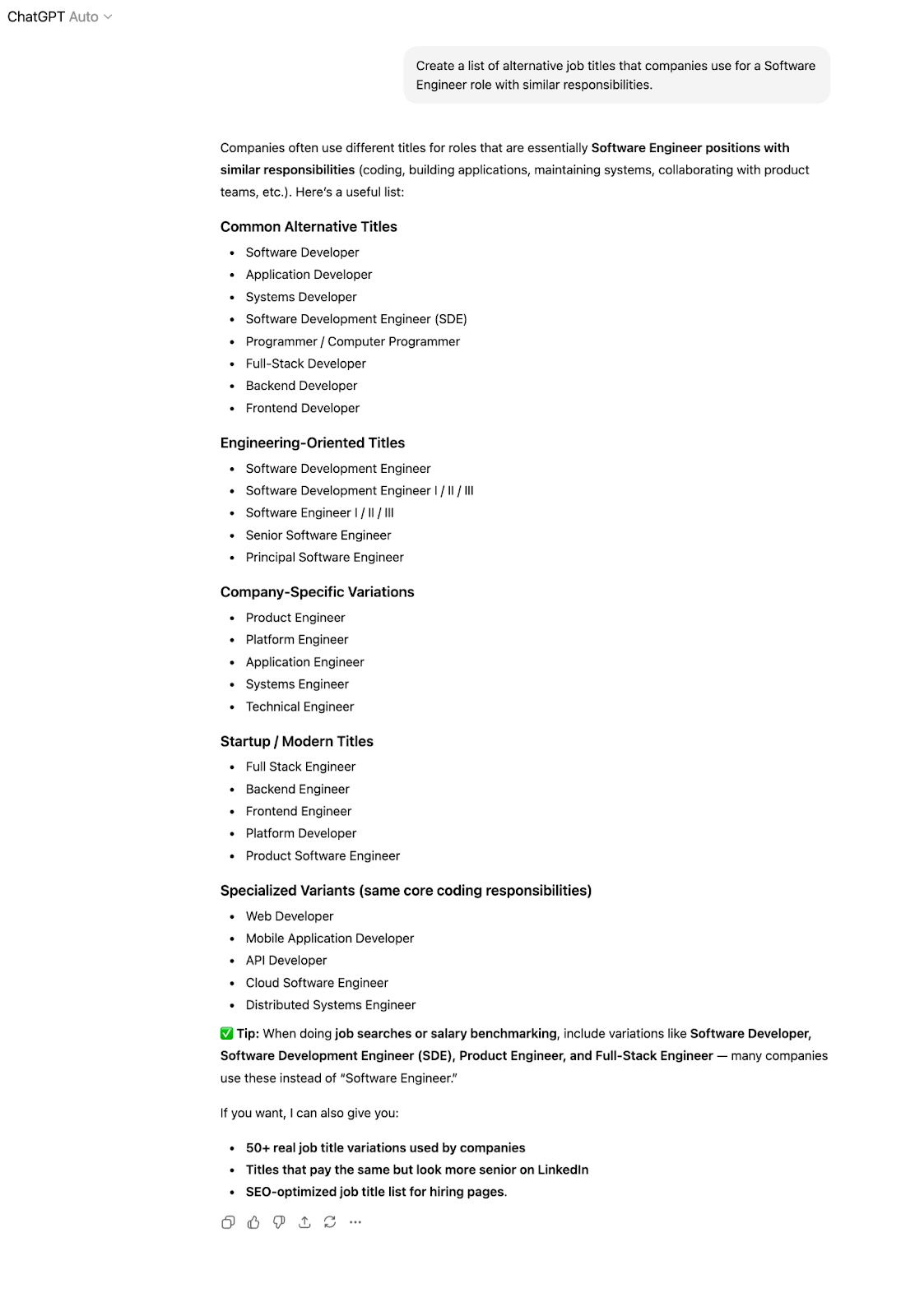
“Create a list of alternative job titles for a [job title] role with similar responsibilities.”
Example:
Software Engineer → Application Developer, Backend Engineer, Platform Engineer, Systems Developer.
This helps recruiters expand search coverage.
Result:
Prompt 2
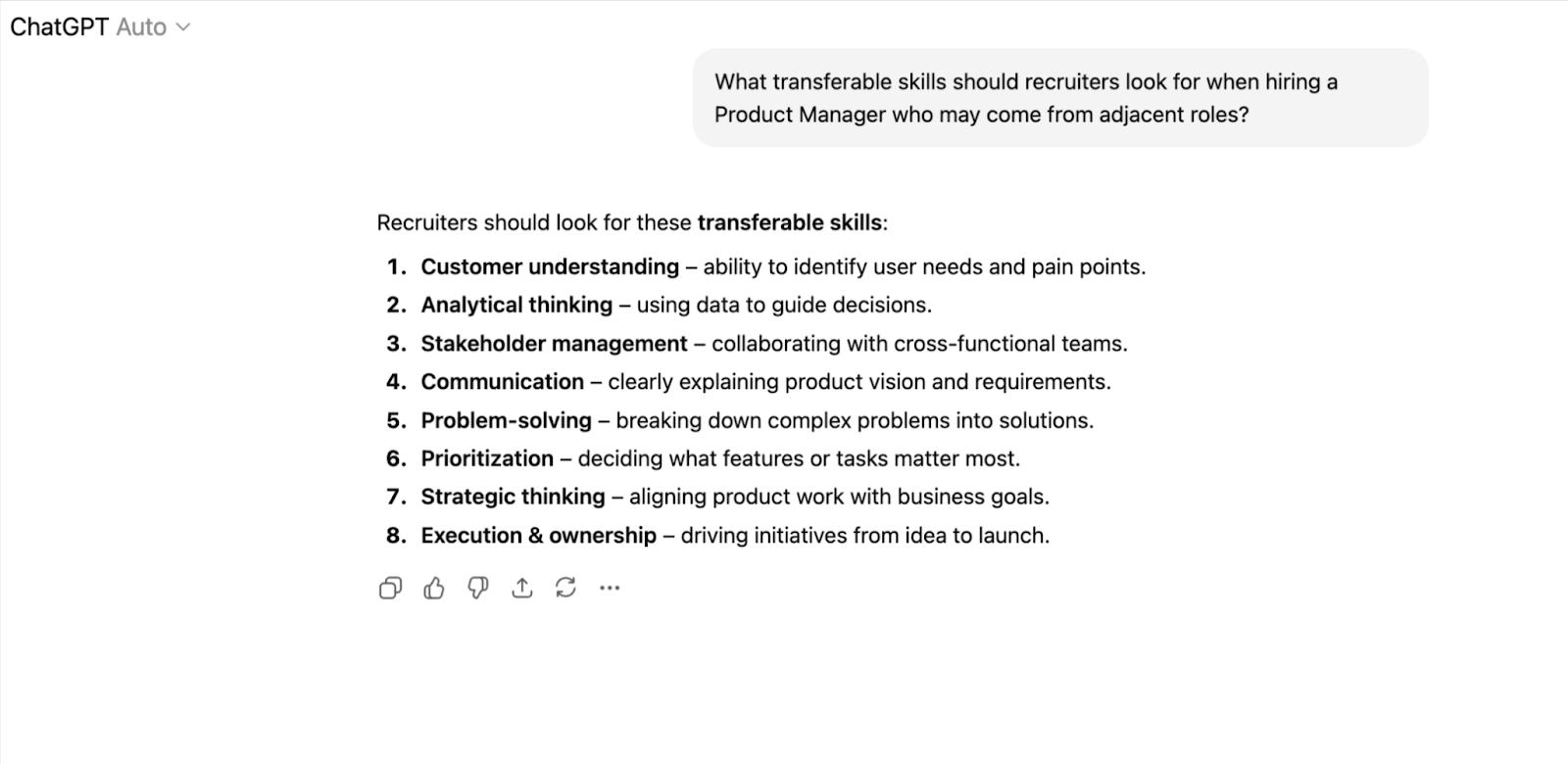
“What transferable skills should I look for when hiring a [job title]?”
Example output might identify adjacent skills that expand candidate pools.
Result:
Prompt 3
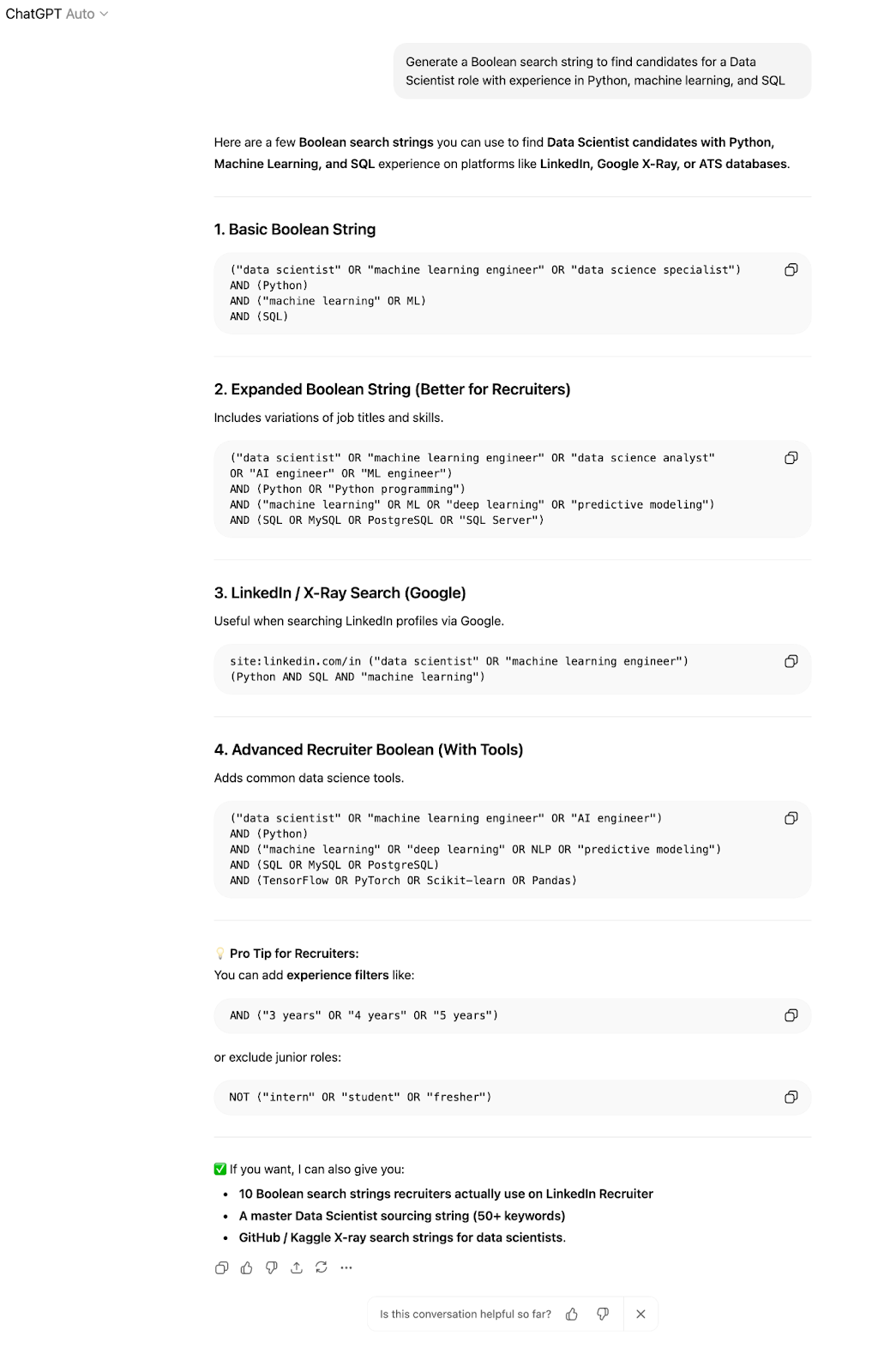
“Generate a Boolean search string to find candidates for a [job title] with skills in [skill1] and [skill2].”
Even if you use AI sourcing tools, this prompt can help you understand keyword relationships.
Result:
Prompt 4
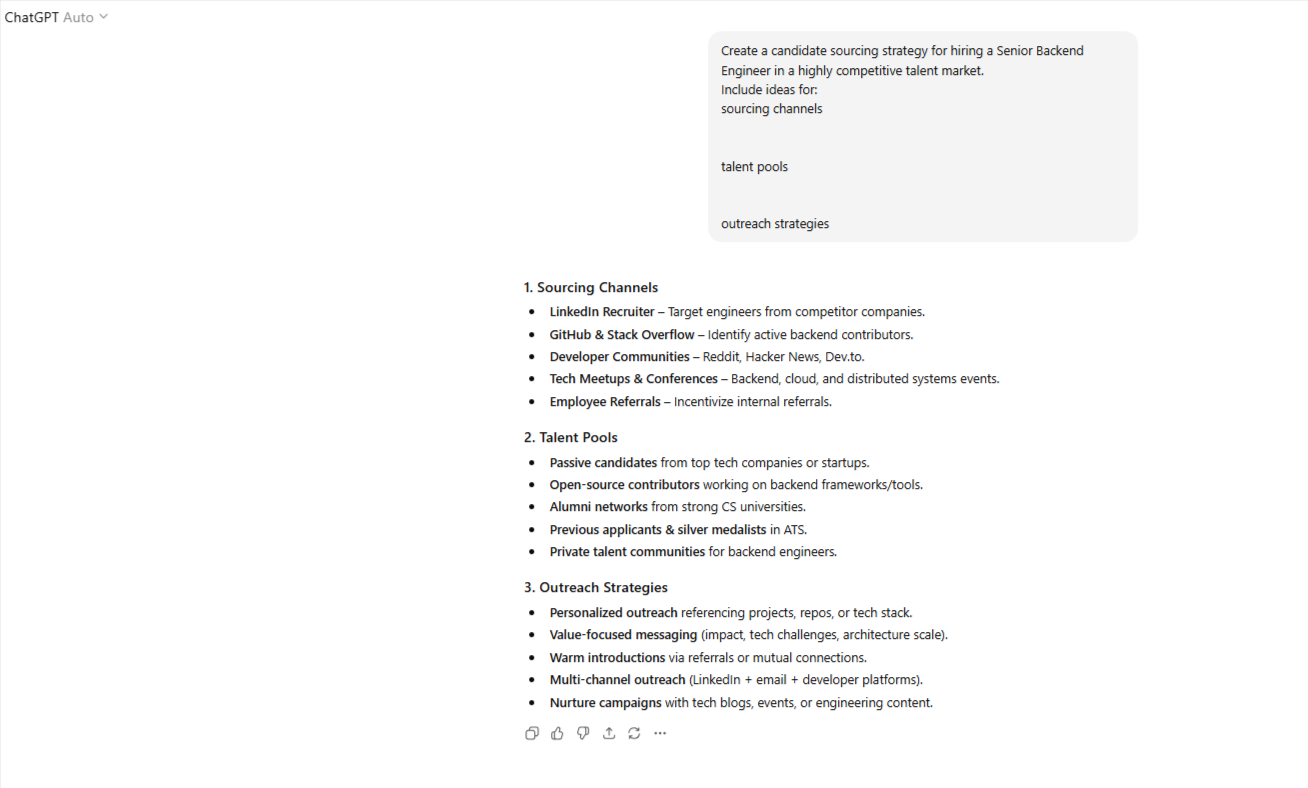
“Create a candidate sourcing strategy for hiring a [job title] in a competitive talent market.”
This prompt produces ideas for:
1. alternative sourcing channels
2. talent pool targeting
3. engagement tactics
Result:
Screening resumes manually takes significant recruiter time. These prompts help summarize and evaluate resumes faster.
Prompt 5
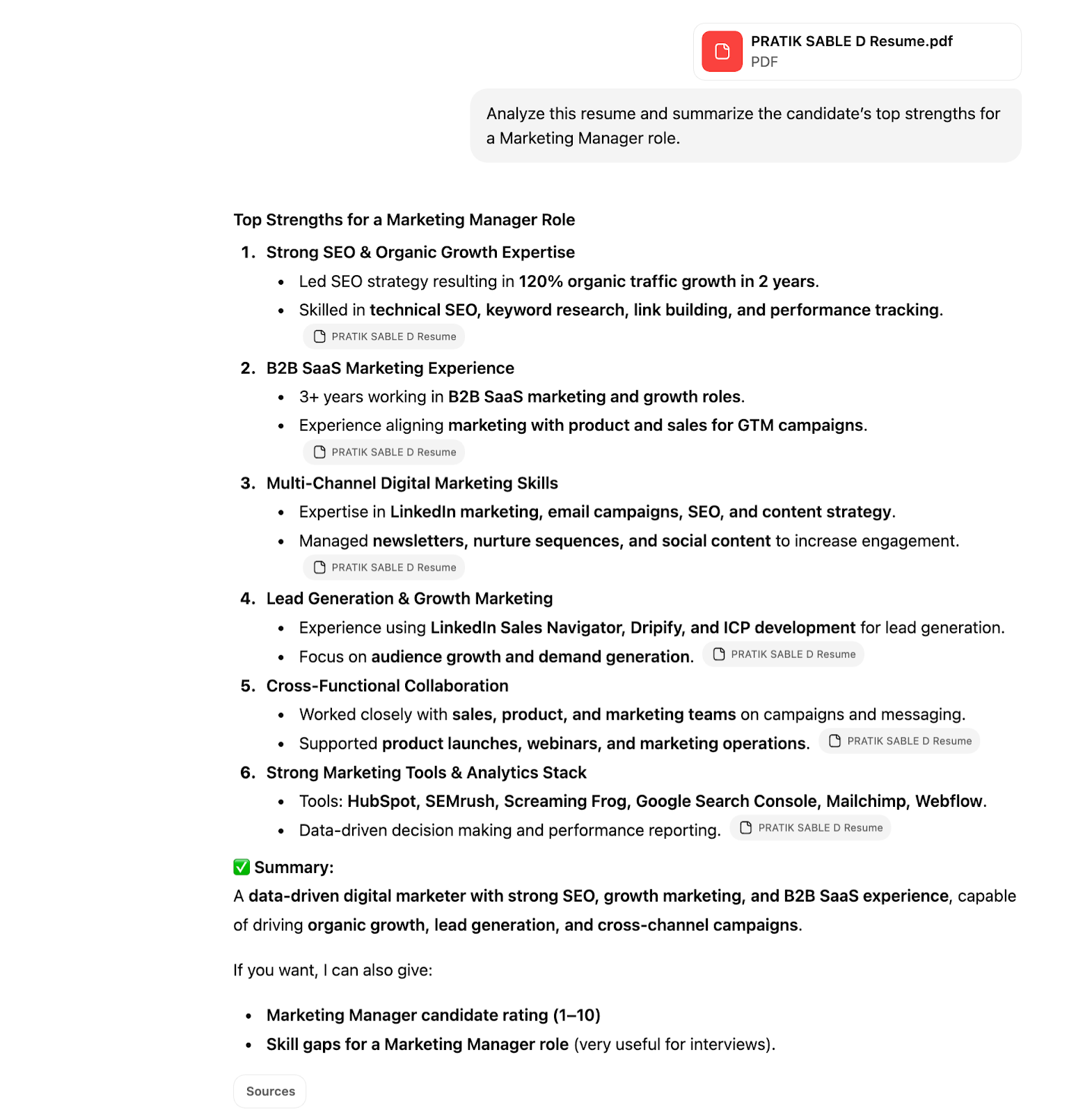
“Analyze this resume and summarize the candidate’s top strengths for a [job title].”
Paste the resume and receive a quick summary.
Result:
Prompt 6
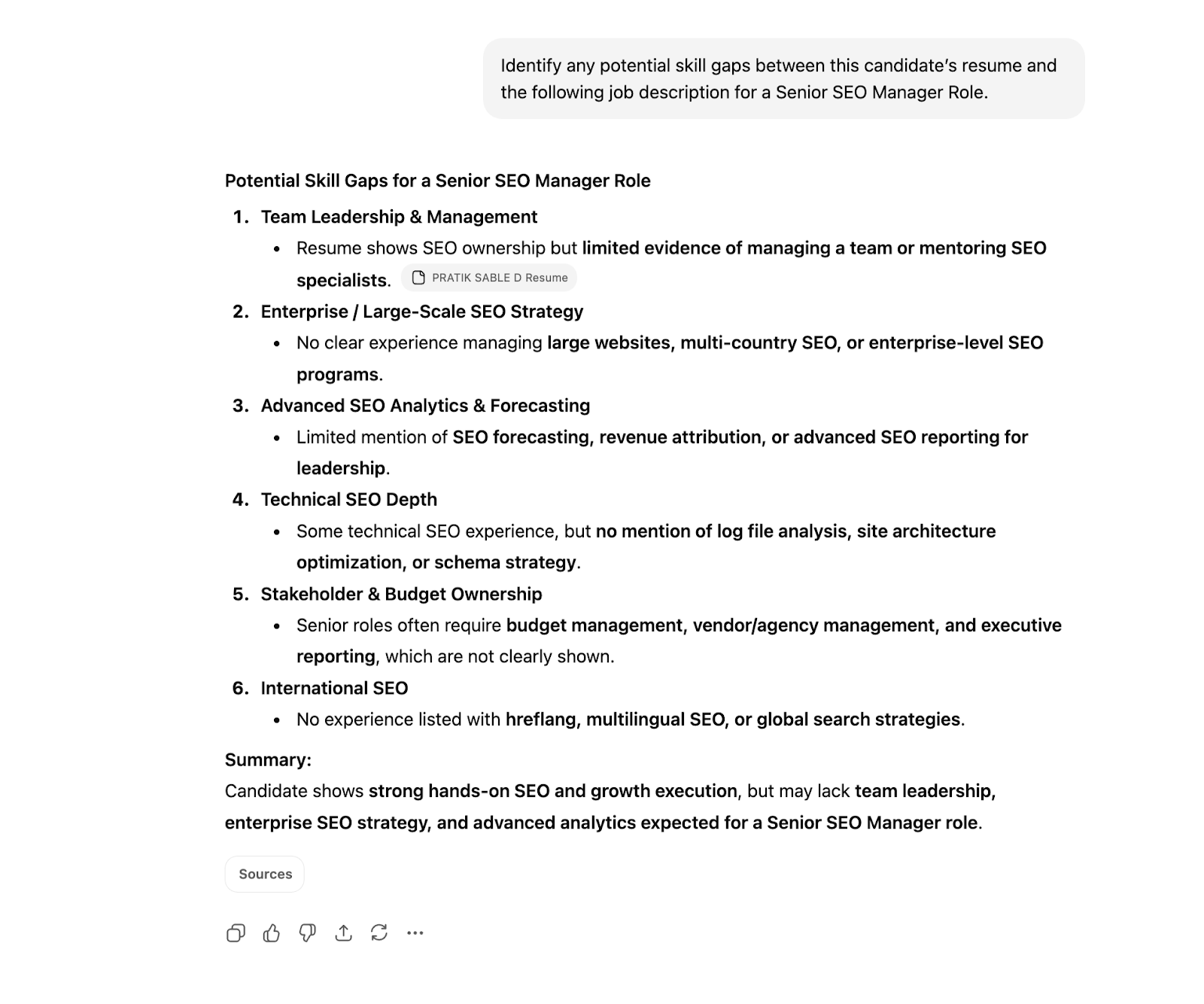
“Identify any potential skill gaps between this candidate’s resume and this job description.”
Useful for screening alignment.
Result:
Prompt 7
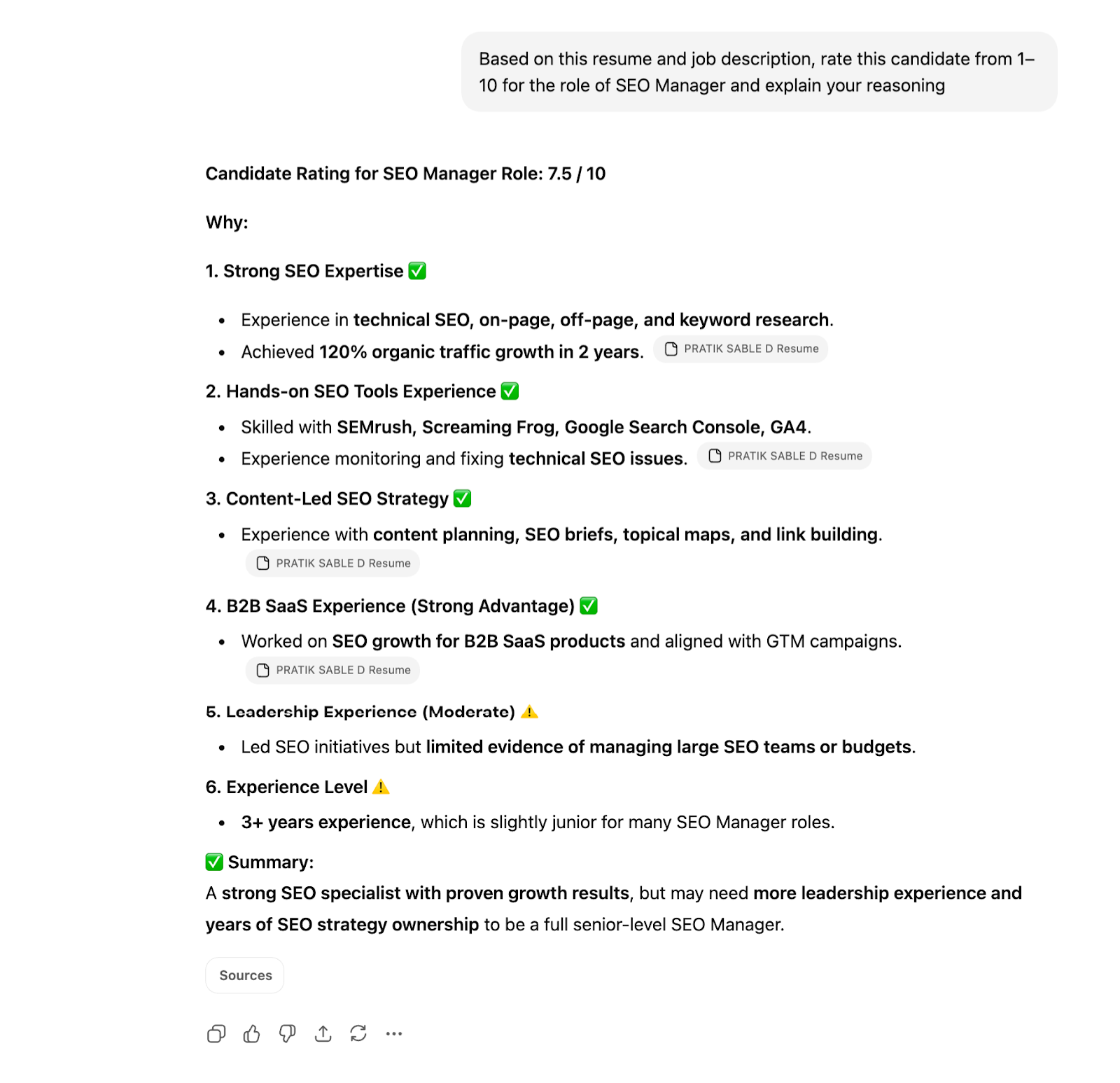
“Rate this candidate from 1–10 for this role and explain the reasoning.”
This creates quick scoring insights.
Result:
Prompt 8
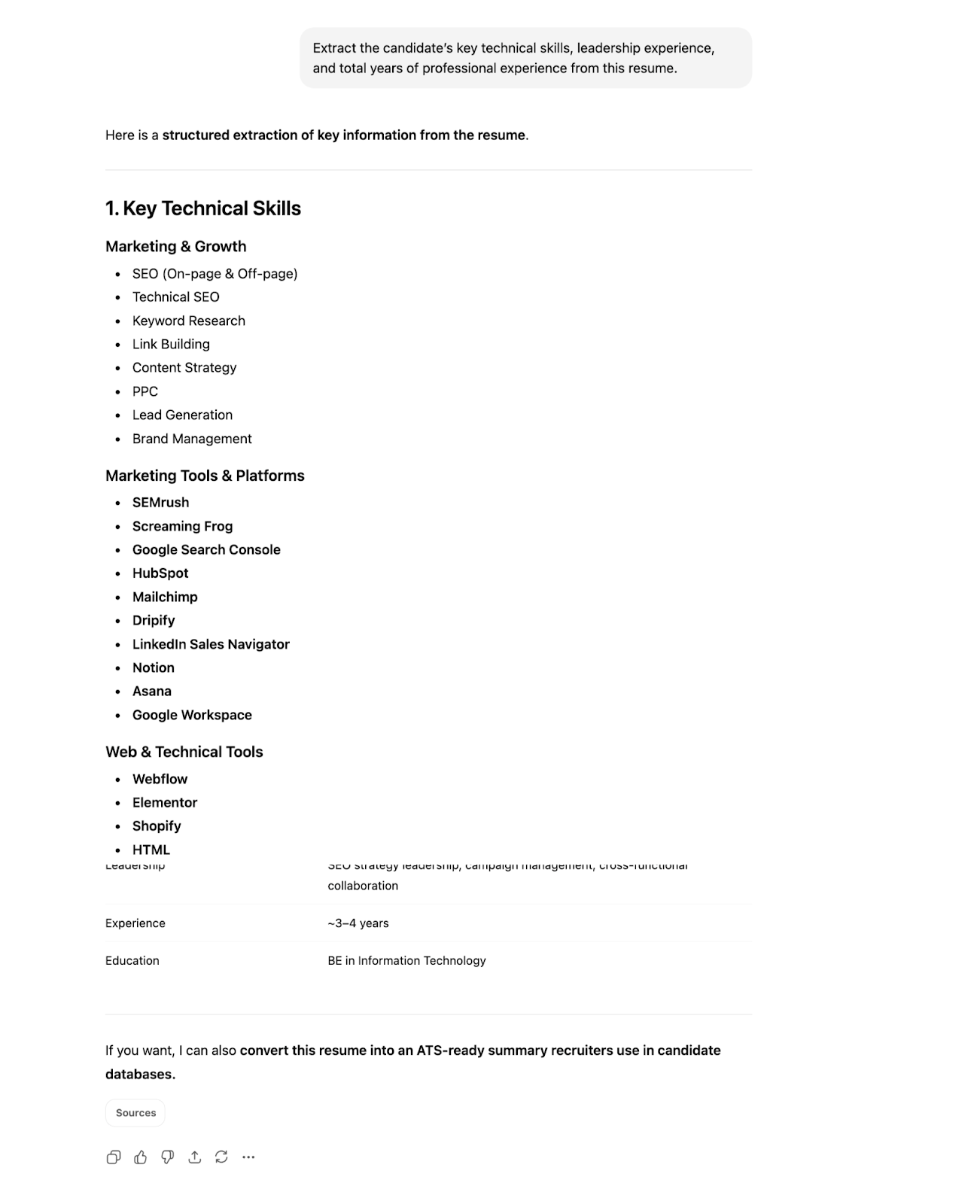
“Extract the candidate’s key technical skills, leadership experience, and years of experience from this resume.”
Helpful for quick structured summaries.
Result:
Recruiters often spend hours writing personalized outreach messages. ChatGPT can accelerate this process.
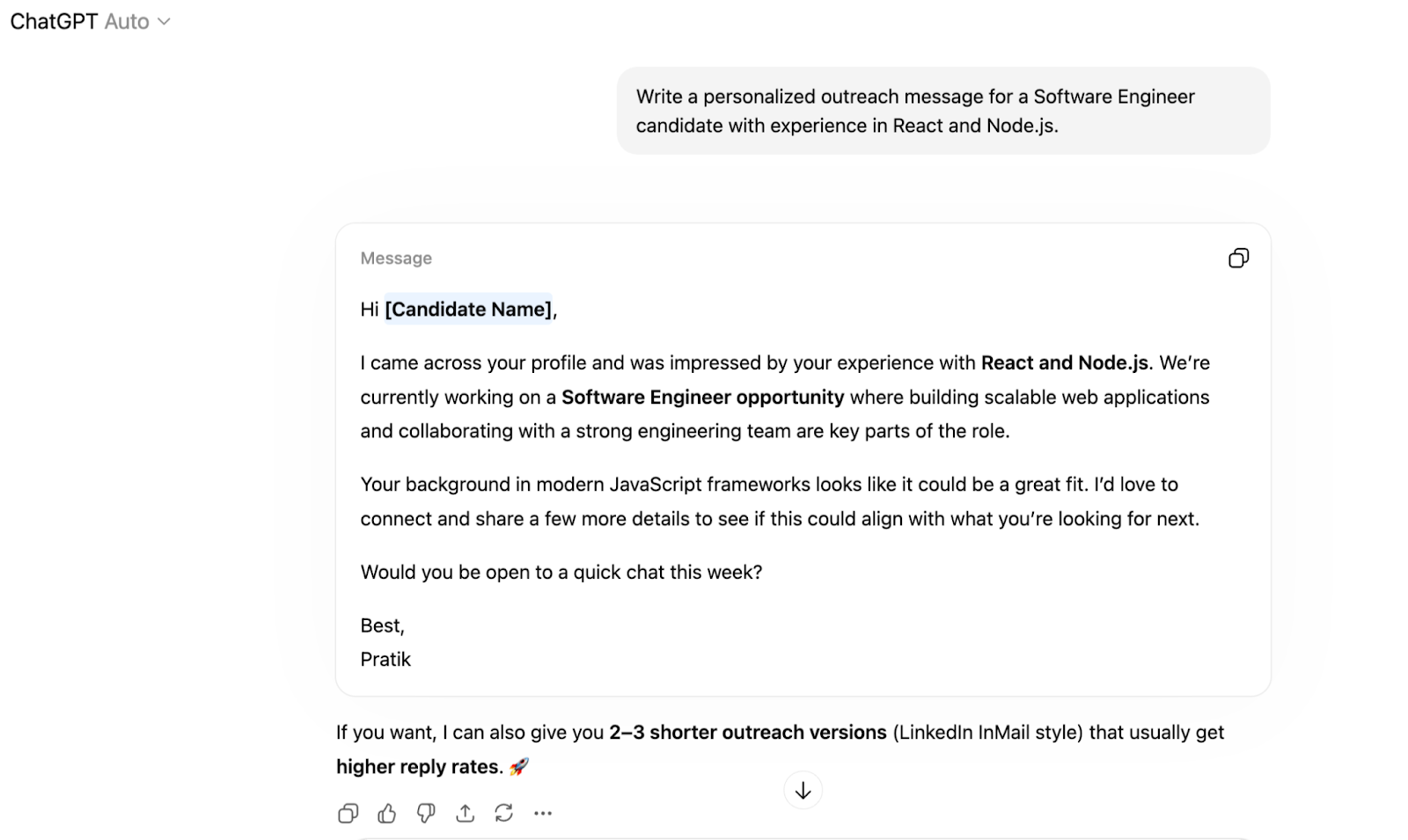
Prompt 9
“Write a personalized outreach message for a [job title] candidate with experience in [skill].”
Result:
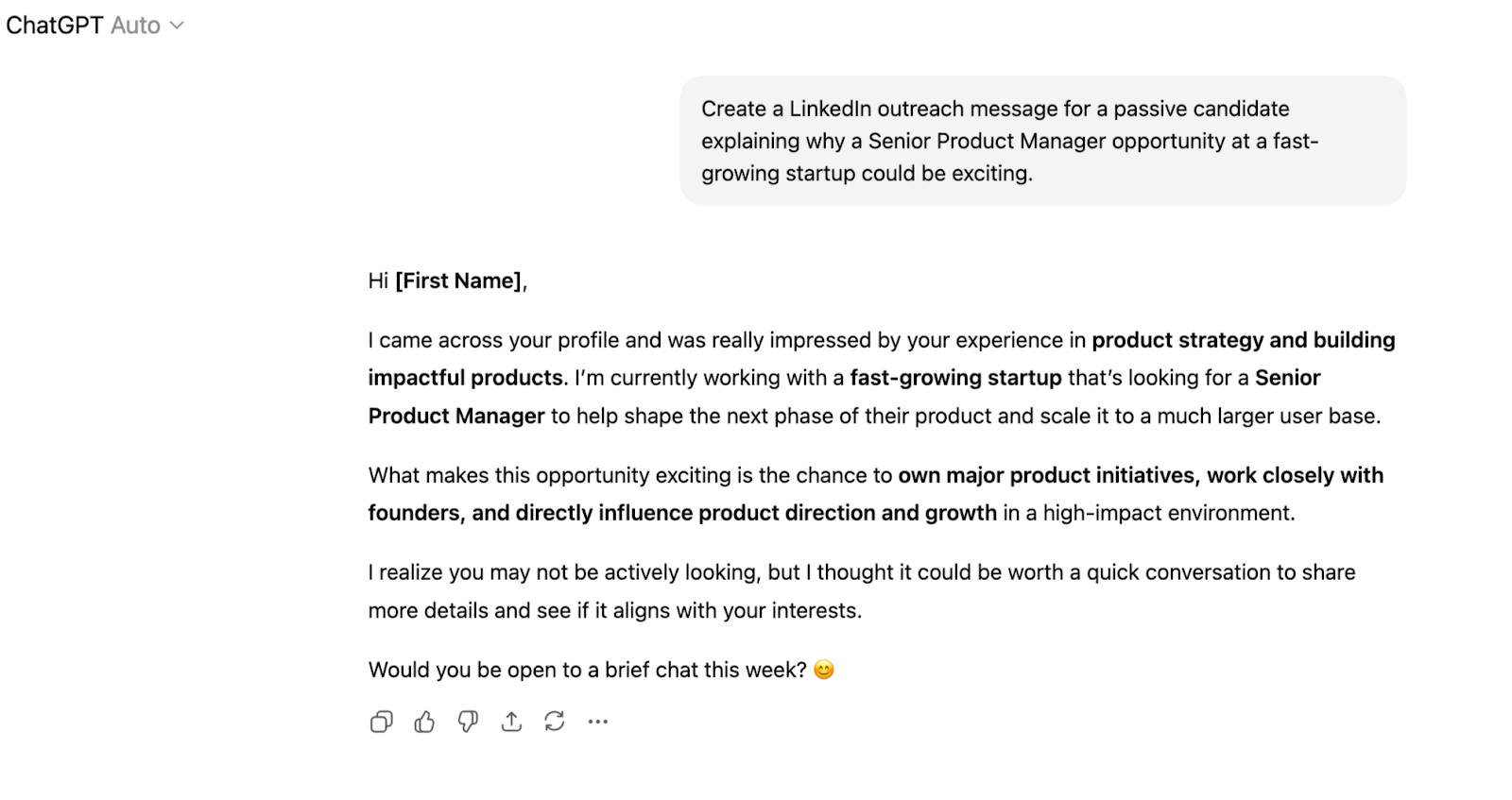
Prompt 10
“Create a LinkedIn outreach message for a passive candidate explaining why this opportunity is exciting.”
Result:
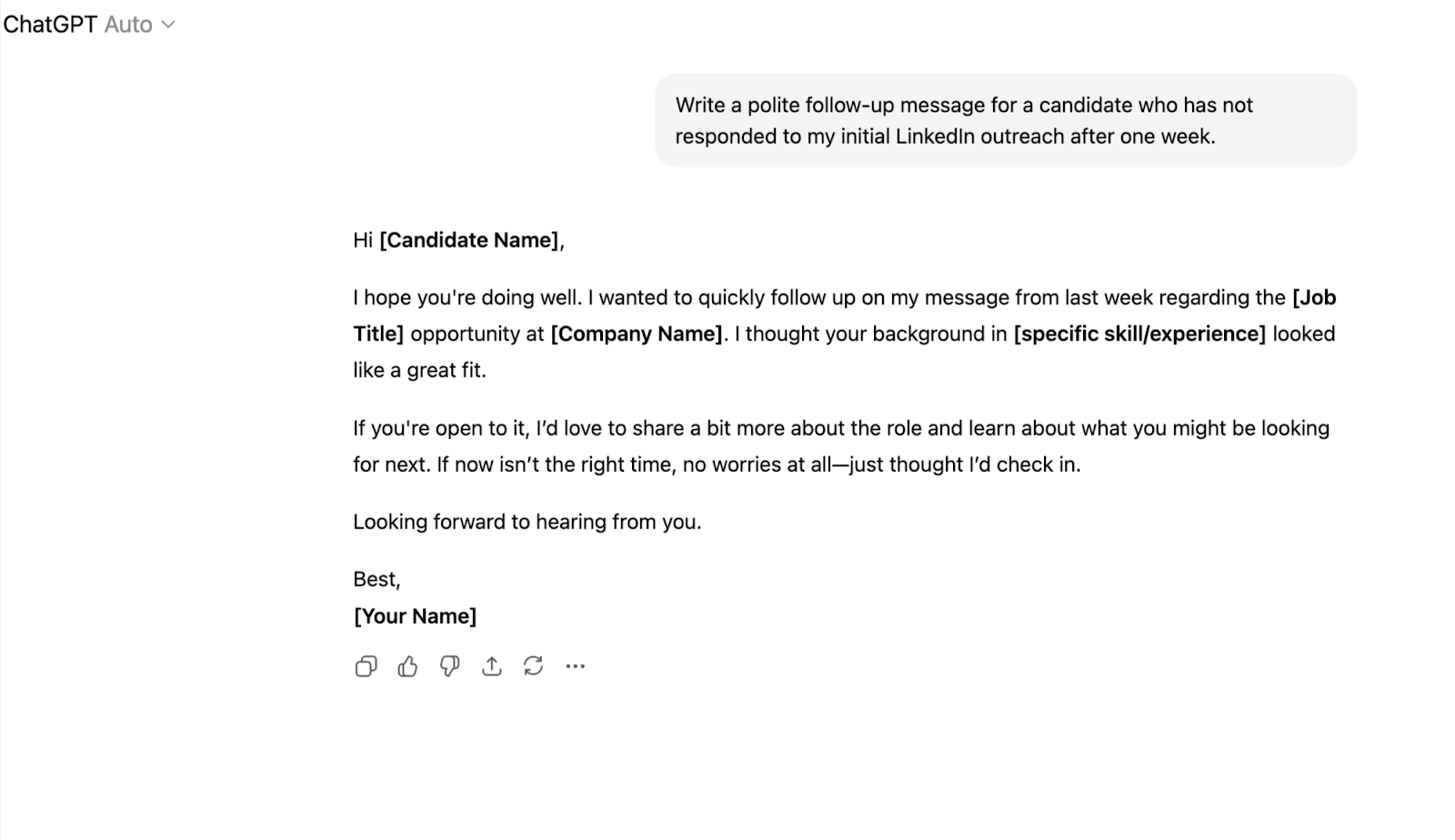
Prompt 11
“Write a follow-up message for a candidate who has not responded to my first outreach.”
Result:
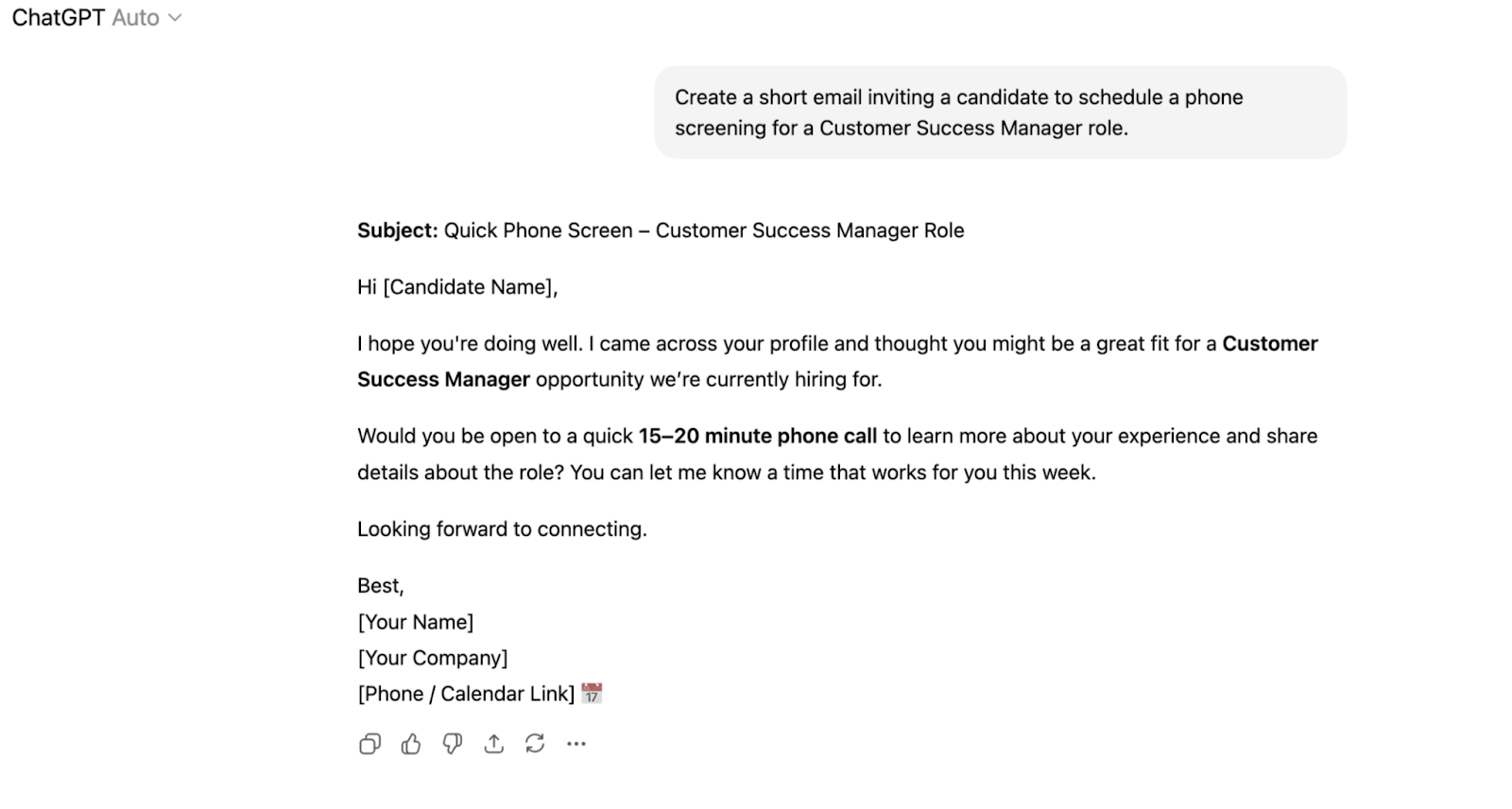
Prompt 12
“Create a short email inviting a candidate to schedule a phone screening.”
Result:
Preparing structured interviews helps recruiters evaluate candidates consistently.
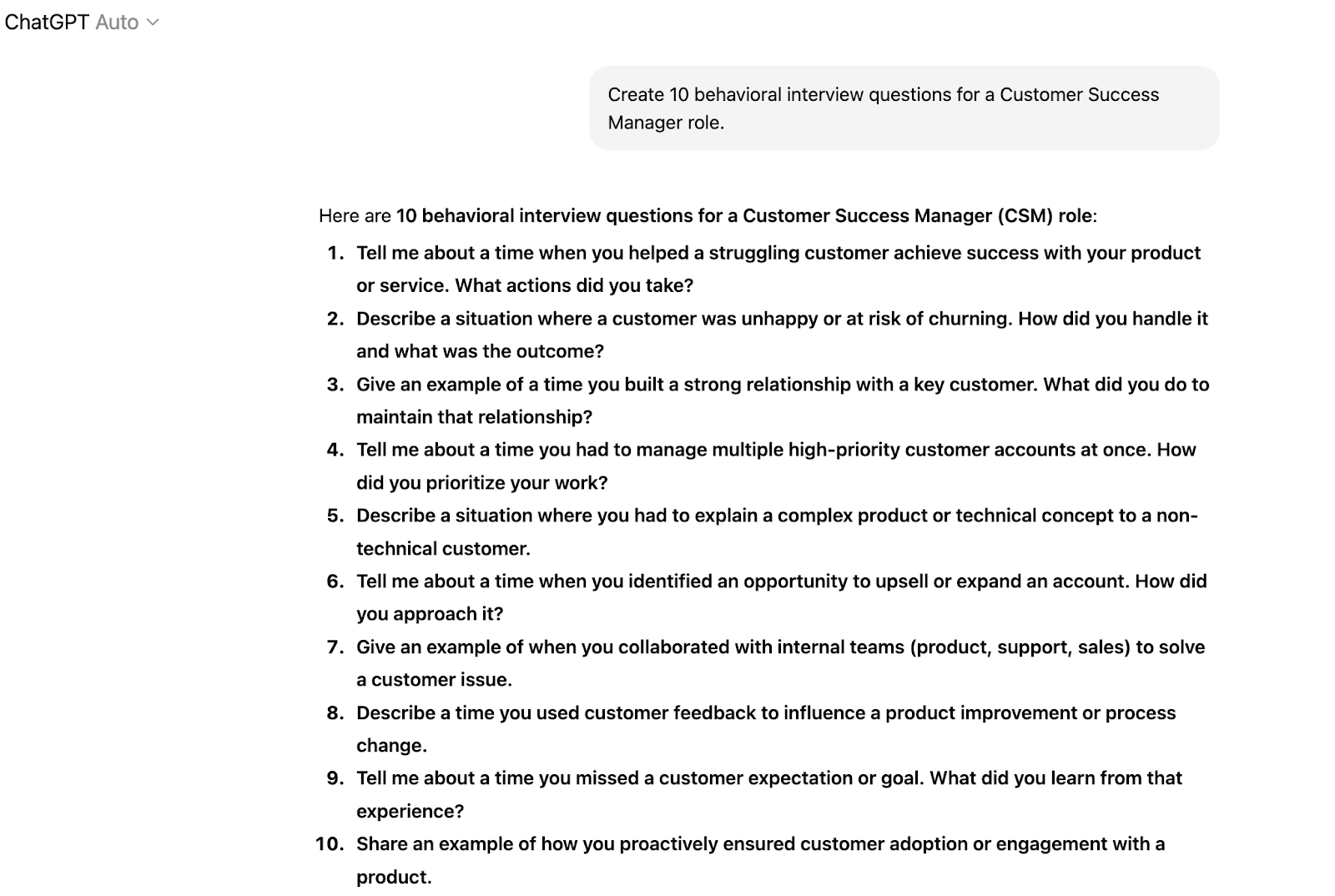
Prompt 13
“Create 10 behavioral interview questions for a [job title].”
Result:
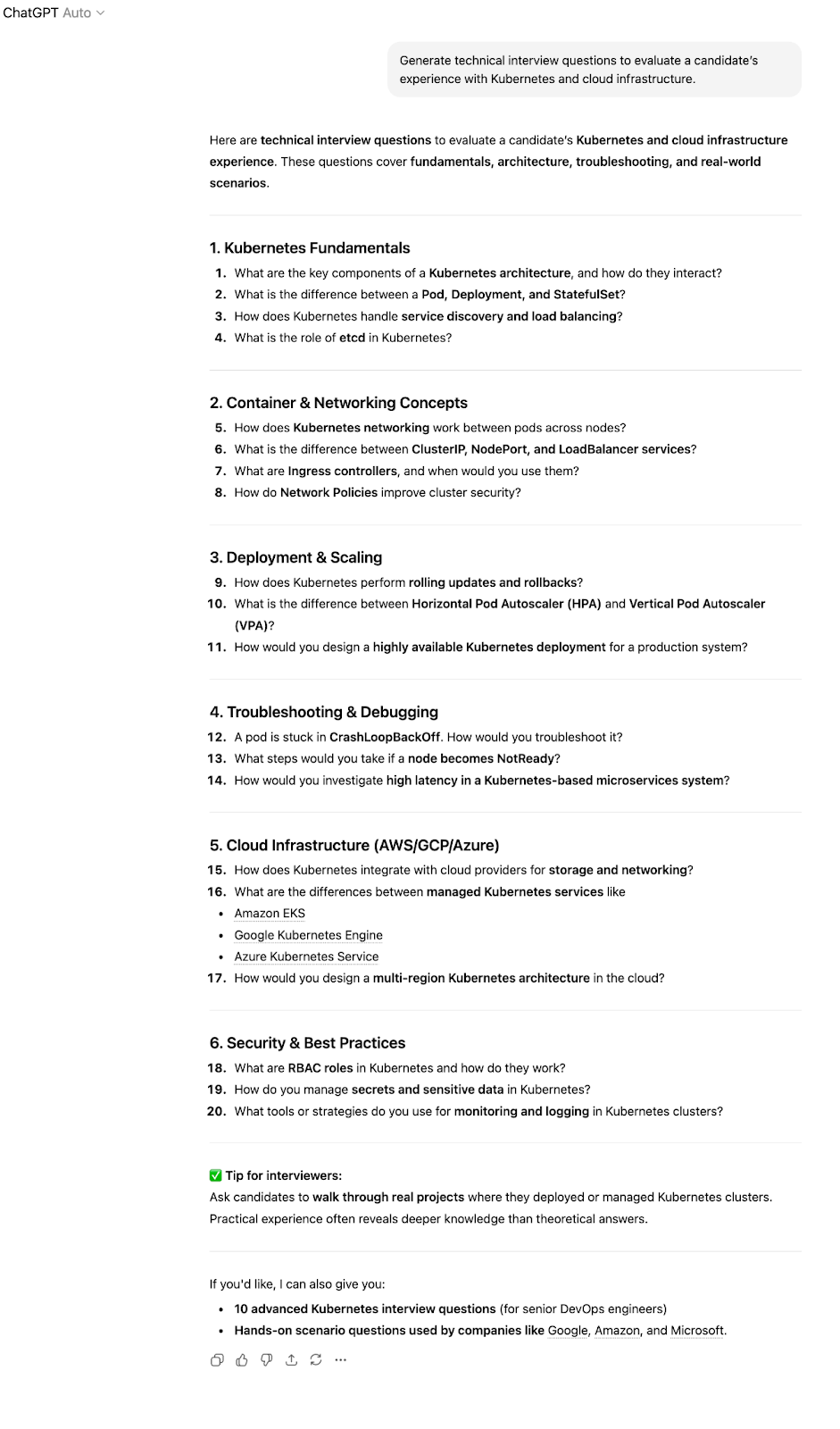
Prompt 14
“Generate technical interview questions for evaluating a candidate’s experience with [technology].”
Result:
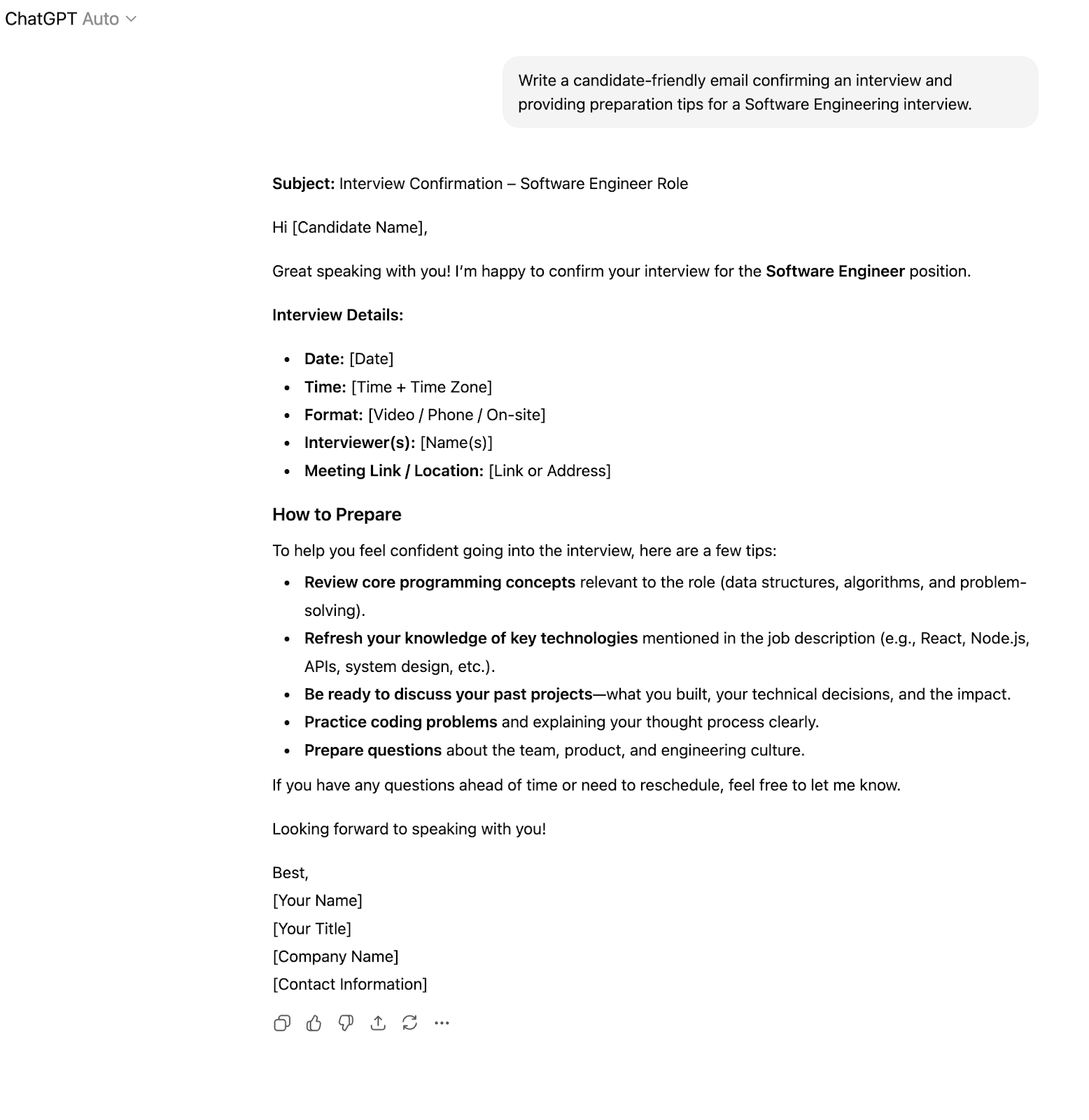
Prompt 15
“Write a candidate-friendly email confirming an interview and providing preparation tips.”
Result:
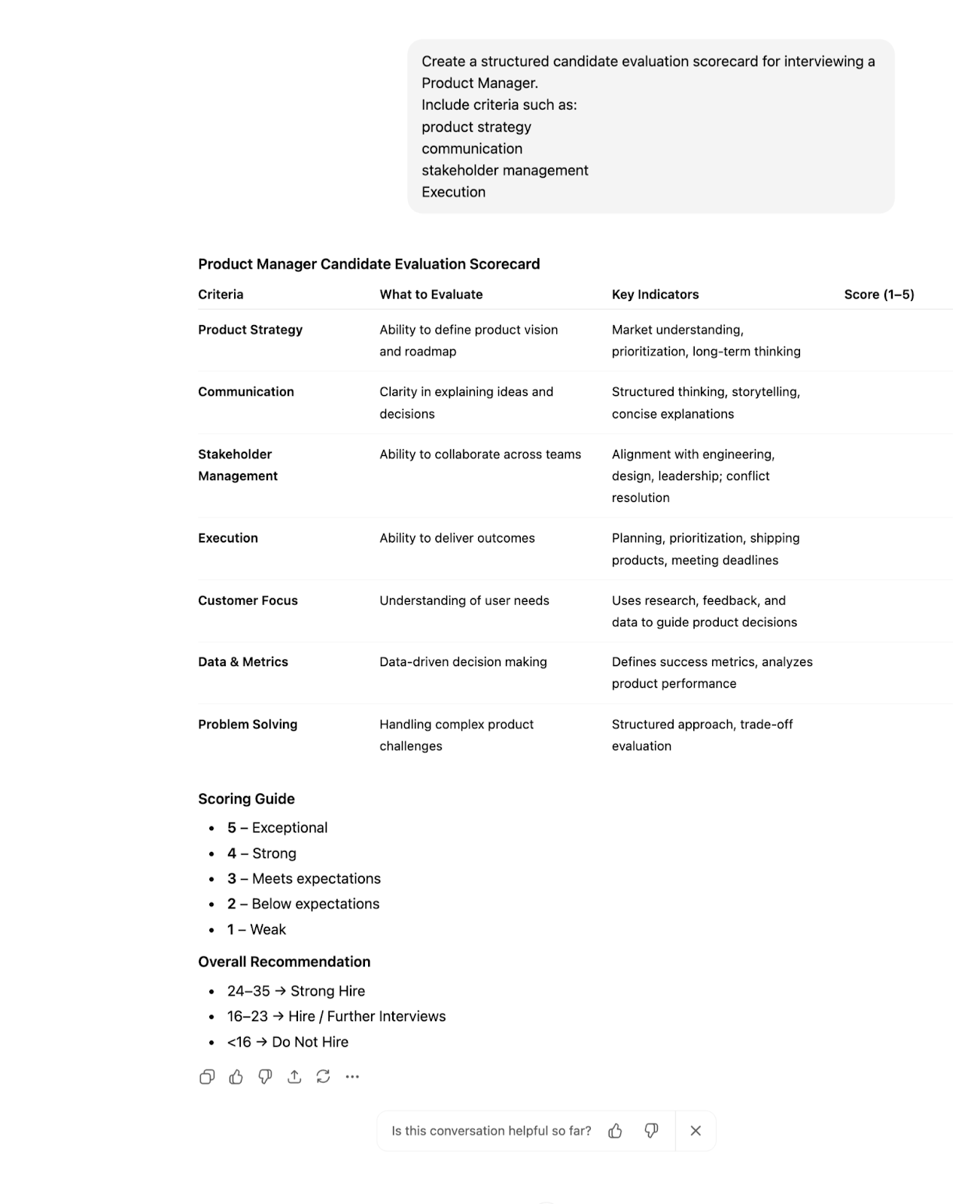
AI prompts can help structure post-interview analysis.
Prompt 16
“Create a candidate evaluation scorecard for a [job title].”
Result:
Prompt 17
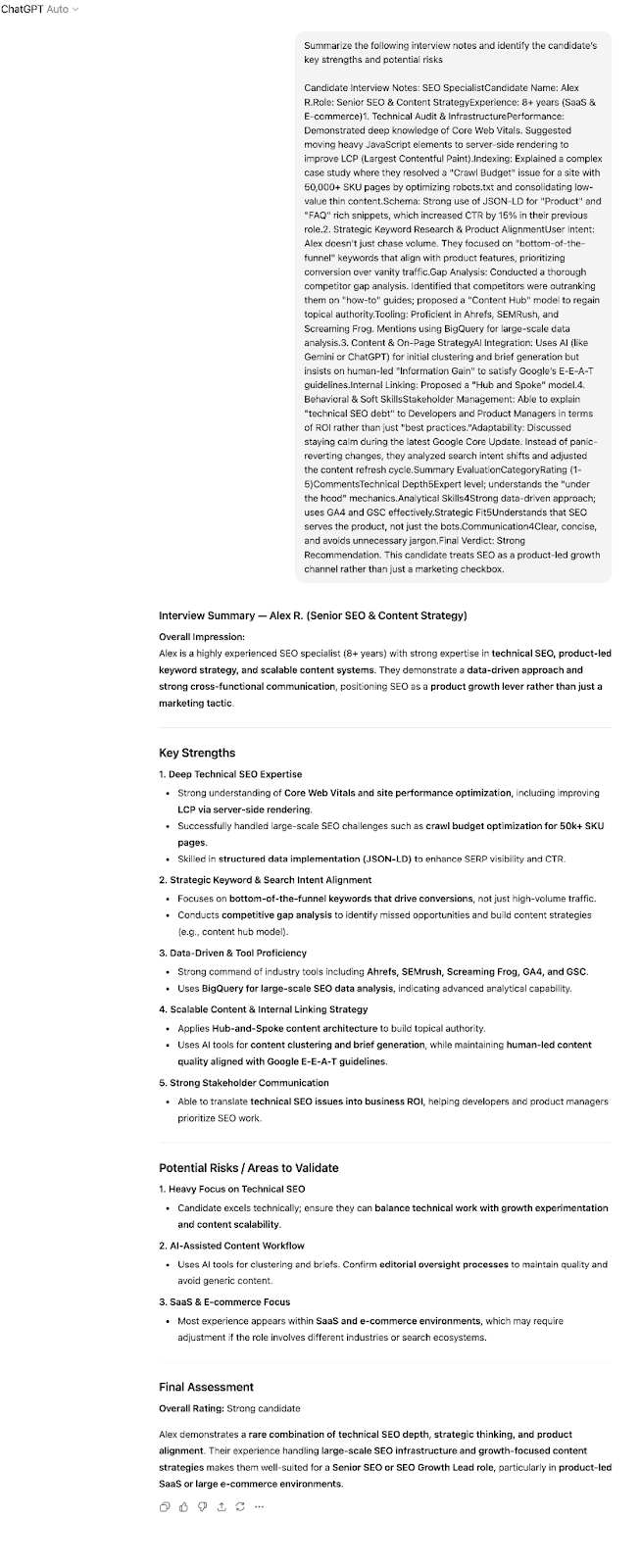
“Summarize interview notes and identify the candidate’s strengths and risks.”
Result:
Prompt 18
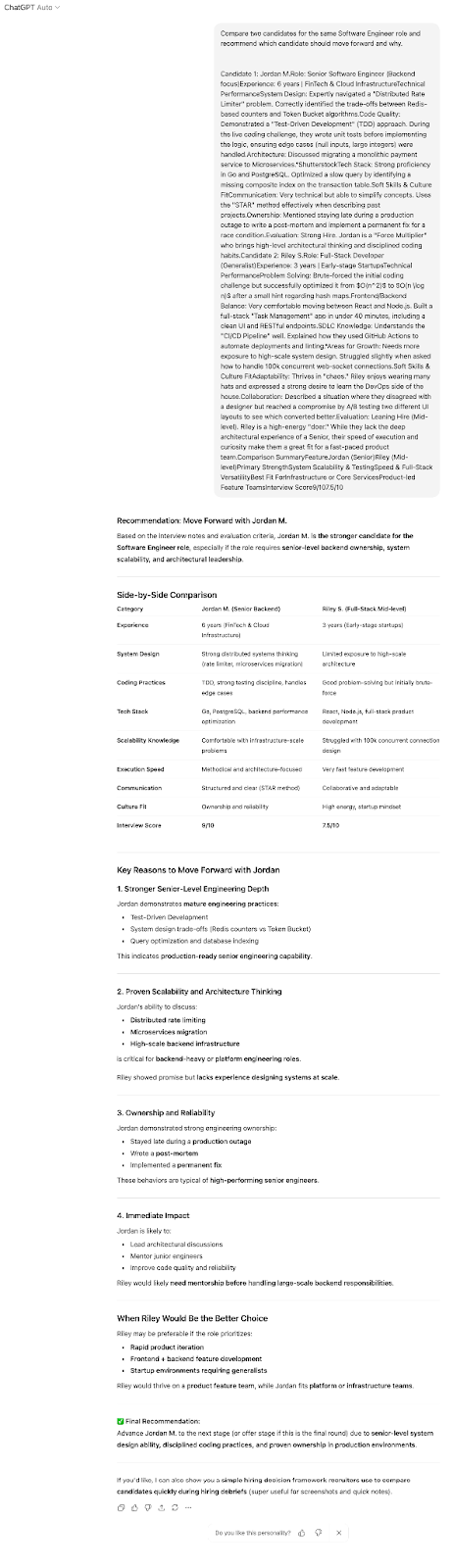
“Compare two candidates for the same role and recommend who should move forward.”
Result:
Writing clear job descriptions and recruiting content is another area where generative AI helps.
Prompt 19
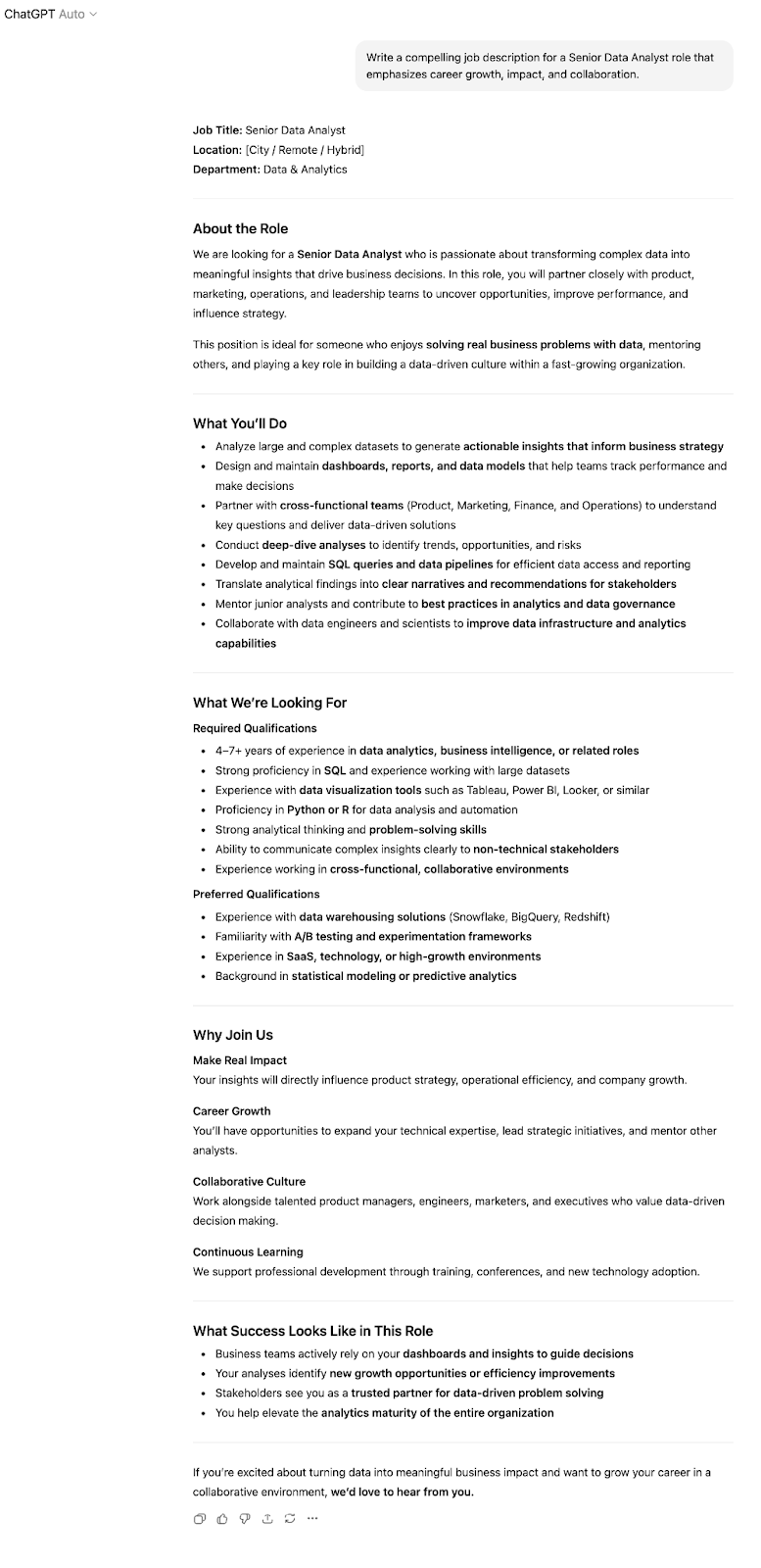
“Write a compelling job description for a [job title] that emphasizes growth and impact.”
Result:
Prompt 20
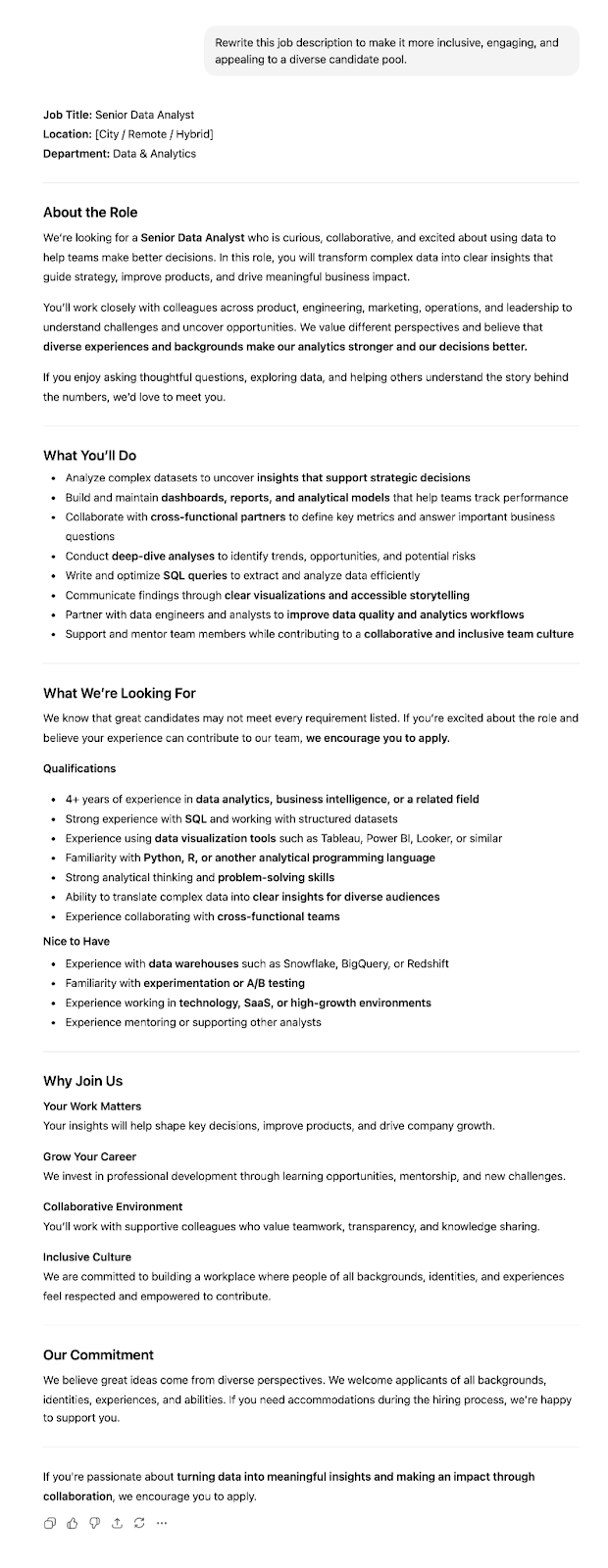
“Rewrite this job description to make it more inclusive and engaging.”
Result:
Prompt 21
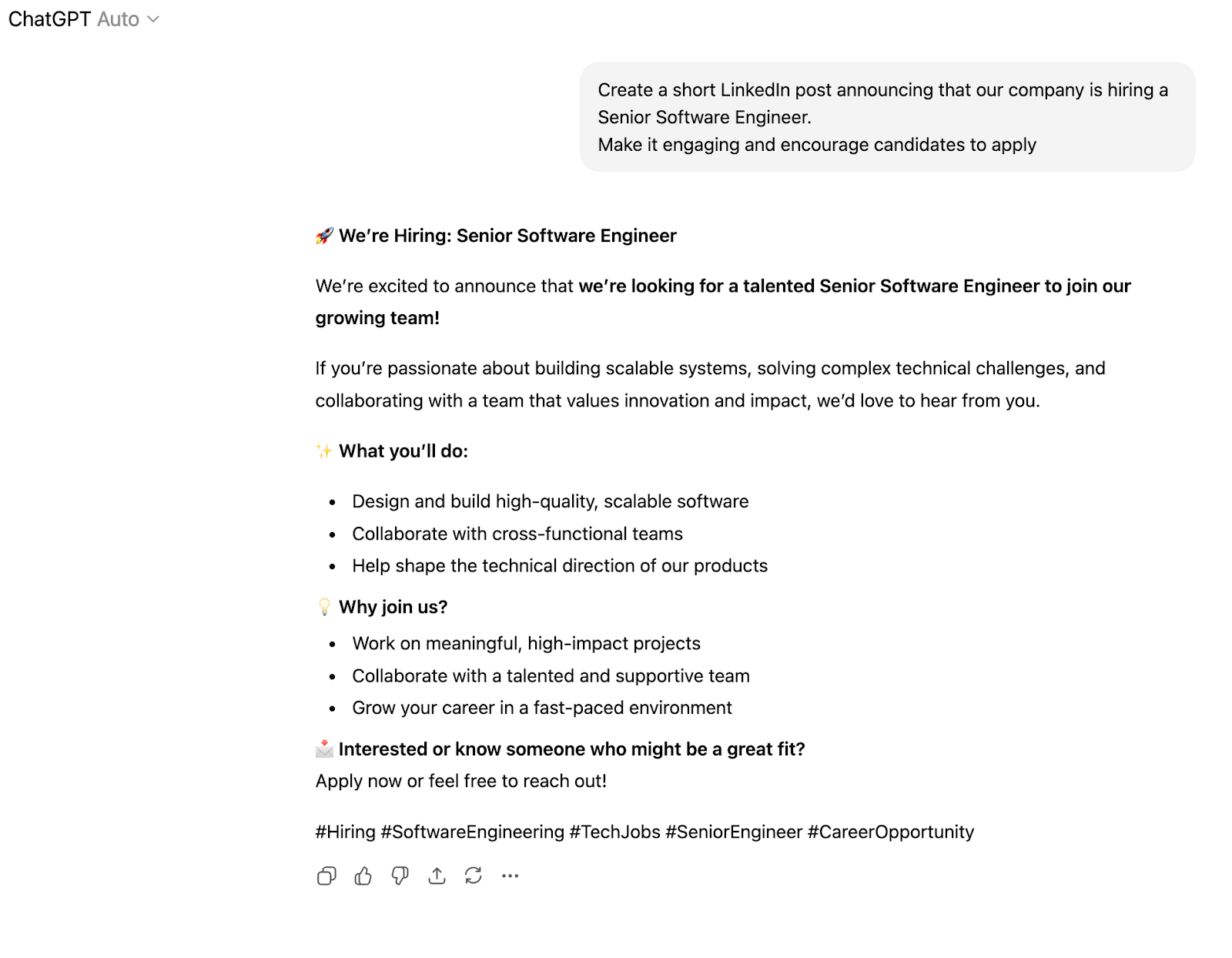
“Create a short LinkedIn post announcing that we are hiring for a [job title].”
Result:
Prompt 22
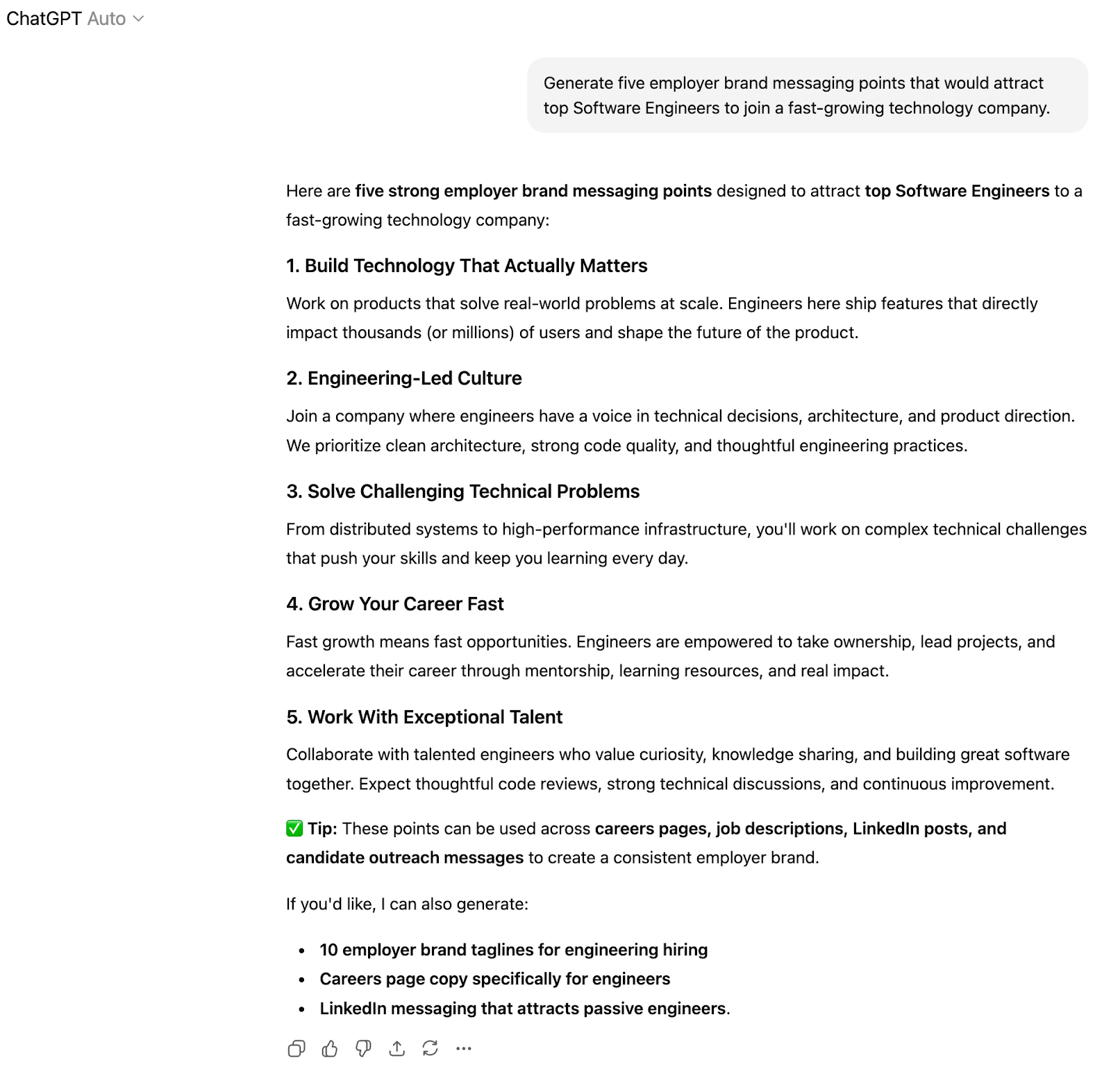
“Generate five employer brand messaging points that would attract candidates for this role.”
Result:
ChatGPT can be extremely useful for brainstorming sourcing strategies, generating outreach messages, and analyzing job requirements. However, when it comes to actual candidate sourcing, there are several limitations recruiters should keep in mind.
1. ChatGPT Cannot Access Real Candidate Databases
ChatGPT does not connect to ATS systems, resume databases, or talent networks. That means it cannot actually find candidates, only help generate ideas for how you might search.
Recruiters still need to run those searches manually.
2. It Relies on Hypothetical Data
When you ask ChatGPT to suggest candidates or sourcing strategies, it works from patterns in its training data rather than real-time talent data. This makes it helpful for planning, but not for identifying specific candidates.
3. It Requires Manual Translation into Search Queries
Even when ChatGPT generates a good Boolean string or sourcing idea, recruiters still need to:
- copy the search logic
- run the search in an ATS or database
- manually refine results
This adds additional steps to the sourcing process.
4. No Built-In Candidate Ranking or Matching
ChatGPT cannot evaluate resumes, identify equivalent job titles across databases, or rank candidates based on fit. These capabilities require machine learning systems specifically trained on recruiting data.
ChatGPT is powerful for generating ideas and content, but it does not search candidate databases or intelligently score candidates with bias-free built-for-recruiting technology.
That is where AI sourcing platforms like Curately come in. Curately’s AI Sourcing module takes the natural-language prompting style recruiters already use in ChatGPT and applies it directly to sourcing.
Instead of building Boolean strings, recruiters can simply describe the candidate they want.
Example prompt:
“Software engineer with C# experience, 10+ years experience, located in Cupertino, CA.”
Curately’s AI then:
- identifies equivalent job titles
- recognizes transferable skills
- analyzes experience levels
- returns ranked candidate matches
Recruiters can then refine results conversationally.
Examples:
“Include surrounding cities.”
“They must also have Java experience.”
“Make C# a must-have skill.”
“Cloud experience can be a nice-to-have.”
This conversational refinement allows recruiters to iterate quickly without rebuilding search strings. Then, selected candidates are synced directly to the recruiter’s ATS and can be added to outreach campaigns, contacted individually, and more.
Recruiters often get the best results by following a few simple guidelines.
1. Start broad, refine later
Begin with a general description of the candidate. Narrow the search after seeing initial results.
2. Use must-have vs nice-to-have criteria
Not every skill should be mandatory. Identifying which skills are essential helps prevent over-filtering
3. Consider equivalent titles
Many candidates use different titles for similar roles. AI sourcing tools automatically account for these variations.
4. Expand geographic radius
If candidate pools are small, expanding location parameters often surfaces strong matches.
5. Iterate conversationally
One of the biggest advantages of AI sourcing is the ability to refine queries through simple prompts rather than rebuilding search logic.
6. From AI Ideas to AI Action
Think of ChatGPT as a brainstorming partner.
Curately’s AI sourcing module turns that brainstorming into actionable candidate searches.
The two complement each other. Recruiters can use ChatGPT for thinking and Curately for sourcing.
Generative AI is transforming how recruiters work.
Tools like ChatGPT help with writing, summarizing, evaluating, and planning. When used well, ChatGPT prompts for recruiters can save hours of manual effort across the hiring process.
But recruiting does not stop at generating ideas; finding & engaging candidates remain critical.
AI sourcing platforms like Curately bridge the gap between AI thinking and AI action. By allowing recruiters to search using natural language prompts, they eliminate the complexity of Boolean search while improving candidate discovery.
The result is a faster, more intuitive sourcing experience.
As AI tools for recruiters continue to evolve, the most successful teams will combine generative AI workflows with purpose-built recruiting platforms.
The recruiters who master prompting will find candidates faster, engage more effectively, and ultimately make better hires.
1. What are the best ChatGPT prompts for recruiters?
The best ChatGPT prompts for recruiters help with sourcing strategies, resume screening, candidate outreach, interview preparation, and job description writing. Effective prompts clearly describe the role, required skills, and desired outcomes so AI can generate more relevant insights.
2. How can recruiters use ChatGPT for recruiting?
Recruiters can use ChatGPT to generate sourcing strategies, summarize resumes, draft outreach messages, create interview questions, and write job descriptions. While ChatGPT helps with content and analysis, dedicated AI recruiting tools are typically used for sourcing and managing candidate pipelines.
3. Can ChatGPT replace recruiter sourcing tools?
ChatGPT can help recruiters think through sourcing strategies and generate search ideas, but it does not search candidate databases directly. AI sourcing tools built specifically for recruiting, such as Curately’s AI sourcing module, allow recruiters to apply natural-language prompts directly to candidate data and return matching profiles.
4. What is the best AI sourcing tool for recruiters?
Curately is one of the most advanced AI sourcing tools available for recruiters. Its AI sourcing module allows recruiters to search for candidates using natural language prompts, intelligently recognizes related job titles and transferable skills, and returns ranked candidate matches that can be refined with must-have and nice-to-have filters.
Curately AI, Inc
6495 Shiloh Rd, Suite 300, Alpharetta GA 30005


We care about your data, and we'd use cookies only to improve your experience. By using this website, you accept our cookie policy. Learn More.
Okay, I Accept