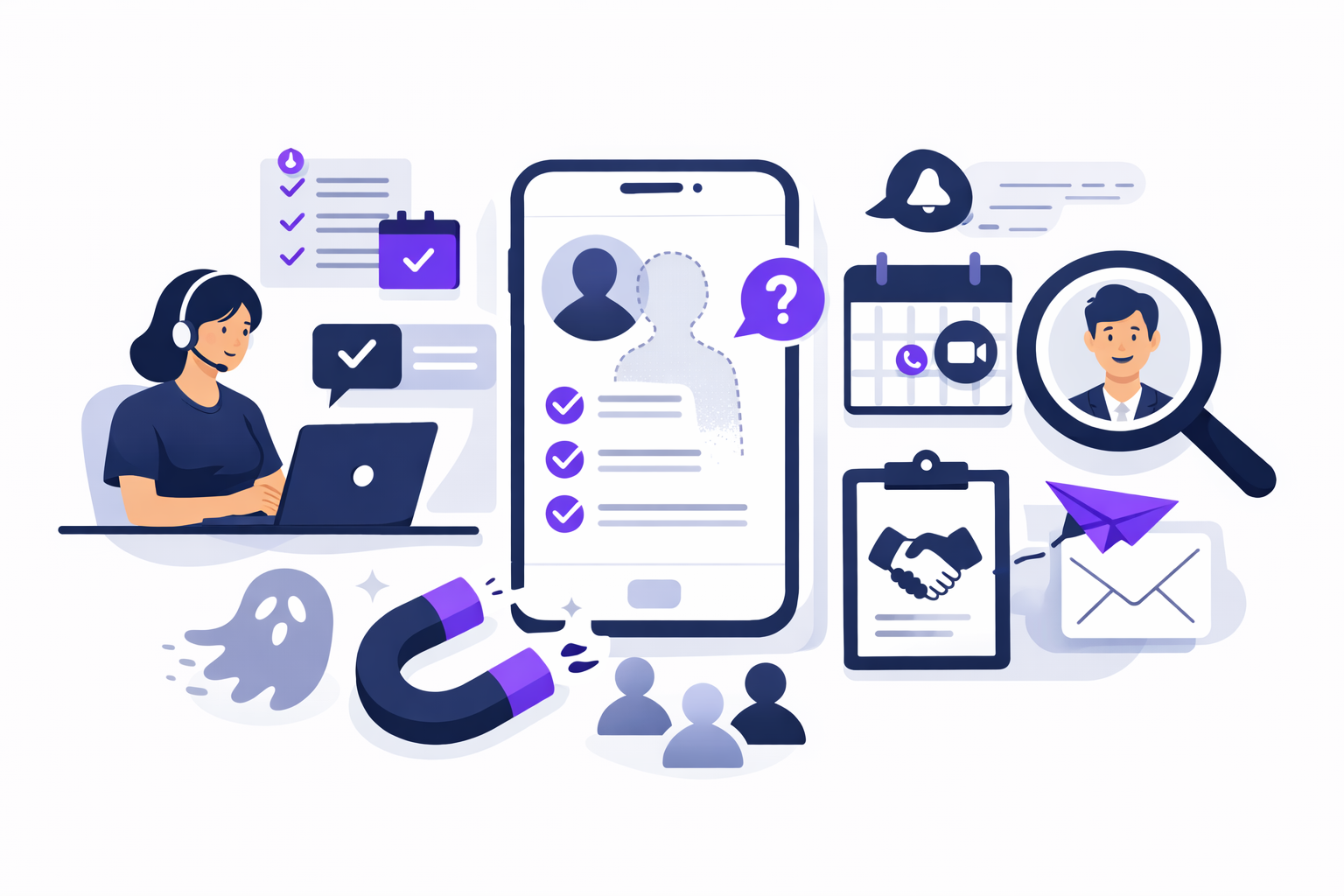
Candidate ghosting has gone from a rare frustration to a daily reality for recruiting teams.
You've probably seen it happen:
A candidate applies, seems interested, even schedules an interview… and then disappears. Repeated attempts to contact them or follow up are met with silence. It's like they just… vanished.
This is candidate ghosting, and it's quietly becoming one of the biggest sources of lost time, lost revenue, and recruiter burnout.
More importantly, it's not random. The important thing to remember is this: Excited and engaged candidates do not ghost potential employers.
Ghosting usually happens because of gaps in the recruiting process. Delays, lack of communication, or poor engagement create opportunities for candidates to drop off.
In this guide, we'll break down:
- What candidate ghosting is
- Why it happens
- The real impact on your business
- How to prevent it
- The top tools that reduce candidate ghosting
If you're trying to improve candidate engagement and reduce hiring process dropouts, this article will help you fix the root causes.
What Is Candidate Ghosting?
Candidate ghosting occurs when a job applicant suddenly stops responding during the hiring process without any notice.
This can happen at multiple stages:
- After applying
- After initial screening
- Before or after interviews
- Even after accepting an offer
So if you're asking "what is candidate ghosting?", the simplest answer is: It's when candidates disengage completely without communication.
It's closely related to:
- candidate no-show in interviews
- recruitment communication gaps
- candidate drop-off rate
According to Indeed, candidate ghosting has become increasingly common in competitive job markets, especially when candidates have multiple opportunities and limited patience for slow hiring processes.
Why It Is Bad for Your Business
Candidate ghosting causes more significant problems than mere inconvenience. If left unchecked, it has measurable impact across your hiring operation.
Lost Time and Productivity
Recruiters spend hours sourcing, screening, and scheduling candidates who never show up. That time is now gone, when ideally it could have been spent nurturing and engaging with top candidates.
Increased Cost per Hire
If you're paying for applicants through job boards or ads, every ghosted candidate increases your true acquisition cost.
Slower Hiring Cycles
Missed interviews and drop-offs delay hiring timelines, forcing teams to restart the process.
Recruiter Burnout
Repeated ghosting leads to frustration. Recruiters end up chasing candidates instead of building relationships, which will quickly hurt team morale and job satisfaction.
Revenue Impact (Especially in Staffing)
In industries like healthcare staffing or high-volume recruiting, missed placements directly translate into lost revenue.
Which Types of Candidates Usually Ghost?
Not all candidates behave the same way. Certain patterns are more common.
High-Demand Candidates
Candidates in competitive roles (engineering, healthcare, logistics) often have multiple offers. They may disengage if another opportunity moves faster.
Passive Candidates
Candidates who were not actively job hunting may lose interest quickly if engagement is delayed or if their expectations are not immediately met.
Early-Stage Applicants
Candidates who applied casually or in bulk are more likely to drop off before interviews.
High-Volume Hiring Candidates
In mass hiring scenarios, candidates often apply to multiple roles at once and forget where they applied. This leads to higher candidate drop-off rates and interview no-shows.
How to Prevent Candidate Ghosting: Tips for Recruiters
Before jumping into tools, it's important to understand that tools only solve ghosting when paired with the right process.
Here are the most effective strategies.
1. Reduce Time-to-First-Contact
Speed matters.
The longer you wait to contact a candidate, the more likely they are to engage with another company.
Responding within minutes instead of hours dramatically improves connection rates.
2. Communicate Clearly and Consistently
Candidates drop off when they feel uncertain.
Set clear expectations:
- next steps
- timelines
- interview process
Regular updates reduce disengagement.
3. Use Multi-Channel Engagement
Relying on email alone is risky.
Use:
- calls
- SMS
- automated reminders
Meeting candidates where they are increases response rates.
4. Simplify the Hiring Process
Long, complex processes increase drop-off.
Reduce:
- unnecessary interview rounds
- repetitive questions
- slow decision cycles
5. Set Expectations Early
Let candidates know:
- how many steps are involved
- how long the process takes
- what happens next
Clarity builds commitment.
Top Tools to Reduce Candidate Ghosting for Recruiters
Candidate ghosting is a serious problem, but thankfully, using the right tools can mitigate it significantly. Specialized recruitment automation tools and candidate conversion platforms close communication gaps, which is the root cause of most ghosting.
Here are some of the most effective tools and categories.
1. Curately (Best Overall for Reducing Ghosting)
Curately stands out because it directly addresses the biggest cause of candidate ghosting: delayed engagement.
Most ghosting happens because candidates are not contacted quickly enough.
Curately solves this with:
Instant Candidate Engagement
Curately's Voice AI recruiter, Maya, reaches out to candidates immediately after they apply.
Instead of waiting hours or days, candidates receive:
- instant calls
- automated screening
- real-time interaction
This dramatically reduces candidate drop-off before the first conversation.
Automated Follow-Ups
Candidates often ghost when follow-ups are inconsistent.
Curately ensures:
- no missed follow-ups
- consistent communication
- automated reminders
AI-Powered Screening
Candidates who are unqualified often drop off mid-process.
Curately screens candidates early, ensuring recruiters focus on engaged and relevant applicants.
Why Curately Is Different
Most tools help with one part of the process.
Curately addresses the entire workflow:
Apply → Engage → Screen → Handoff
This closes the engagement gap that causes ghosting. Curately also integrates directly with leading ATS and HR tools, enabling a seamless experience for both candidates and recruiters alike.
2. Interview Scheduling Tools
Best for: reducing interview no-shows
Scheduling tools automate:
- calendar coordination
- reminders
- rescheduling
Candidates receive automatic reminders, reducing missed interviews.
Limitation: Does not solve early-stage ghosting.
3. SMS and Communication Platforms
Best for: improving candidate responsiveness
SMS tools increase response rates compared to email.
They are useful for:
- reminders
- quick updates
- confirmations
Limitation: Requires manual workflows without automation.
4. Applicant Tracking Systems (ATS)
Best for: managing candidate pipelines
ATS platforms help organize candidates and track progress.
Limitation: Most ATS systems do not actively prevent ghosting. They track it.
5. Chatbots and Conversational AI Tools
Best for: early-stage candidate engagement
Chatbots can answer questions and guide candidates through initial steps.
Limitation: Often limited to text-based interaction and early funnel stages.
Candidate Ghosting Statistics 2025 (Context)
Rather than talking in generalizations or anecdotes, let's look at some hard data. Indeed's Ghosting in Hiring Report states that 3 in 5 job seekers in the U.S. (61%) have ghosted anywhere from two to four employers in the past 12 months. According to research from SHRM, employers report increasing rates of candidate ghosting, particularly in tight labor markets where candidates have more options.
Additionally, 54% of hiring managers state that they have been ghosted by a Gen Z candidate after extending an offer. With Gen Z making up an ever-increasing share of the workforce, this issue will likely become even more common.
These trends reinforce a simple truth:
Ghosting is often a process problem, rather than a candidate problem.
Conclusion
Candidate ghosting is one of the most frustrating challenges in modern recruiting.
But it is also one of the most solvable.
Most ghosting happens because of:
- slow response times
- inconsistent communication
- long hiring processes
When you fix those issues, ghosting drops significantly.
Tools that reduce candidate ghosting do not just automate workflows. They improve engagement at every stage of the hiring process.
Among these tools, Curately stands out because it addresses the root cause directly:
Speed and consistency of candidate engagement.
By combining AI-driven outreach, automated screening, and real-time communication, Curately helps recruiting teams reduce drop-offs and convert more applicants into hires.
In a competitive hiring market, the companies that engage candidates first and follow up consistently are the ones that win.
Frequently Asked Questions
What is candidate ghosting?
Candidate ghosting is when a job applicant stops responding during the hiring process without any notice, often before interviews or after initial communication.
Why do candidates ghost recruiters?
Common candidate ghosting reasons include slow response times, poor communication, long hiring processes, and receiving competing job offers.
How can recruiters reduce candidate ghosting?
Recruiters can reduce ghosting by improving response speed, maintaining consistent communication, simplifying the hiring process, and using tools that automate engagement and follow-ups.
What tools help reduce candidate ghosting?
Tools that reduce candidate ghosting include AI engagement platforms like Curately, scheduling tools, SMS communication platforms, and conversational AI tools that improve candidate responsiveness throughout the hiring process.