



Curately AI, Inc
6495 Shiloh Rd, Suite 300, Alpharetta GA 30005
We care about your data, and we'd use cookies only to improve your experience. By using this website, you accept our cookie policy. Learn More.
Okay, I AcceptLearn how to combine AI with talent sourcing. Discover practical workflows, tools, and strategies for AI-powered candidate sourcing and recruiting
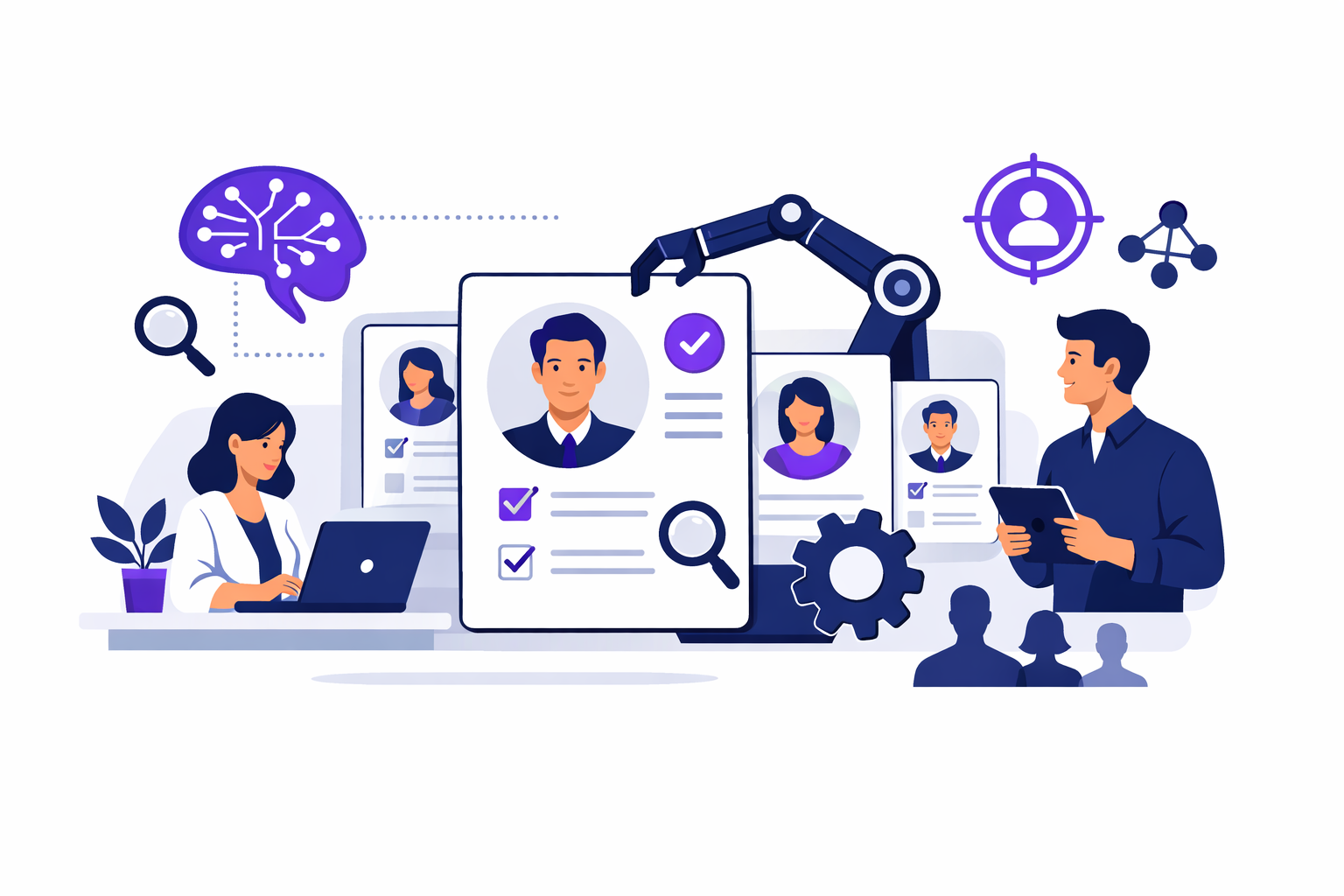
Talent sourcing has changed significantly over the past few years.
Recruiters are no longer just posting jobs and waiting for applicants. Rather, in 2026 sourcing involves actively identifying, engaging, and nurturing candidates across multiple channels. At the same time, candidate expectations have increased, and hiring timelines have tightened.
This is why many teams are turning to AI talent sourcing to improve how they find and engage candidates. In fact, over 40% of organizations now leverage AI in HR tasks, up from just over 25% in 2024.
When used effectively, AI can help recruiters identify candidates faster, prioritize the right profiles, rediscover overlooked talent, and engage candidates earlier in the hiring process.
This guide explains how to combine AI with talent sourcing in a practical, workflow-driven way, not just as a set of tools, but as part of a modern recruiting process.
At a basic level, AI talent sourcing refers to using artificial intelligence to support how recruiters find, evaluate, and engage candidates.
This can include:
But combining AI with sourcing is not just about adding new tools.
To be successful, AI needs to be integrated into the day-to-day sourcing workflow so that it supports how recruiters already work.
Instead of replacing human judgment, AI acts as a layer that:
The most effective approach combines AI capabilities with recruiter expertise, creating a more efficient and scalable sourcing process.
To understand how to combine AI with sourcing, it helps to break the process into stages.
AI does not just impact one part of sourcing but actually influences the entire workflow, from discovery to early engagement.
The first step in sourcing is identifying potential candidates.
Traditionally, this involves:
AI candidate sourcing tools change this process.
Instead of relying solely on keyword searches, AI systems can:
This allows recruiters to discover candidates who may not appear in traditional searches. This helps teams to expands sourcing beyond reactive hiring into more proactive pipeline building.
Once candidates are identified, the next challenge is prioritization.
When sourcing at scale, recruiters often face large candidate pools. Reviewing every profile manually is time-consuming.
AI-powered talent sourcing solutions can:
This does not replace recruiter decision-making, but it helps focus attention. Instead of reviewing hundreds of profiles, recruiters can start with the most relevant candidates first.
This is especially useful in high-volume hiring environments where speed matters.
One of the most overlooked sourcing opportunities for organizations is their existing candidate database. Most organizations already have thousands of candidates stored in their ATS or CRM systems. The challenge is that these candidates are often difficult to rediscover.
AI can help by:
This is often referred to as ATS rediscovery. Instead of starting from scratch for every role, recruiters can reuse and re-engage candidates who are already known to the organization.
This reduces sourcing time and improves overall efficiency.
Outreach is one of the most time-intensive parts of sourcing.
Writing personalized messages, following up with candidates, and managing responses can take significant effort.
AI recruitment tools can support outreach by:
Important note: The goal here is not to remove personalization or treat candidates like products on an assembly line, but to make a high quality candidate experience scalable. Recruiters can still control messaging and tone, while AI handles repetitive tasks. This allows teams to engage more candidates without sacrificing quality.
One of the biggest bottlenecks in sourcing is what happens after a candidate responds.
Recruiters often need to:
AI can streamline this stage through automated candidate screening and engagement.
For example, AI systems like Curately’s AI voice agent Maya can:
This allows sourcing and screening to work together instead of operating as separate steps.
Candidates move through the early stages of the hiring process faster, and recruiters spend less time on repetitive screening tasks.
When AI is integrated effectively into sourcing workflows, it creates measurable improvements.
1. Faster Candidate Identification
AI reduces the time required to find relevant candidates.
Instead of relying solely on manual searches, recruiters can quickly surface candidates who match role requirements.
2. Improved Candidate Quality
AI-powered matching helps identify candidates based on skills and experience, not just keywords.
This can improve the overall quality of candidate shortlists.
3. Increased Recruiter Productivity
Automation reduces time spent on repetitive tasks such as:
Recruiters can focus more on relationship-building and decision-making.
4. Better Use of Existing Talent Pools
AI helps organizations make better use of existing candidate data.
Rediscovering candidates in the ATS reduces the need for constant external sourcing.
5. Scalable Sourcing Workflows
AI allows recruiting teams to handle larger volumes of candidates without increasing workload.
This is especially important for organizations managing:
AI talent sourcing is most effective when implemented thoughtfully.
Below are practical best practices for integrating AI into sourcing workflows.
1. Keep Humans in the Loop
AI should support recruiters, not replace them.
Recruiters still play a critical role in:
AI works best as a tool that enhances human judgment.
2. Start with High-Impact Roles First
Not every role requires the same level of sourcing effort.
Organizations should begin by applying AI sourcing to:
This allows teams to see immediate impact and refine workflows before expanding.
3. Ensure Data Quality and ATS Integration
AI systems rely on data.
If candidate data is incomplete or outdated, AI recommendations may be less accurate.
Organizations should focus on:
Strong data improves AI performance.
Many AI tools focus on individual parts of the sourcing process, such as matching or outreach. These are called “point solutions”.
In contrast, Curately takes a more integrated approach by combining sourcing, engagement, and screening into a unified workflow, meaning it supports recruiting teams with a seamless process from “find” to “filled”.
With Curately, recruiters can:
One of the key advantages is how sourcing connects directly to engagement: Instead of identifying candidates and then manually reaching out, recruiters can move candidates into automated engagement and screening workflows. This reduces delays between sourcing and qualification, which is often where candidate drop-off occurs.
By connecting sourcing with screening and pipeline management, Curately helps teams create a more continuous and efficient hiring process.
In 2026, a successful talent sourcing strategy necessitates identifying the right candidates quickly, engaging them effectively, and moving them through the hiring process efficiently.
AI is becoming an essential part of that process.
By combining AI with talent sourcing, organizations can:
The most effective approach is not to rely on AI alone, but to integrate it into a structured, human-centered recruiting workflow.
Recruiters who adopt this approach will be better equipped to manage growing hiring demands while maintaining strong candidate experiences.
Curately AI, Inc
6495 Shiloh Rd, Suite 300, Alpharetta GA 30005


We care about your data, and we'd use cookies only to improve your experience. By using this website, you accept our cookie policy. Learn More.
Okay, I Accept