Choosing an AI recruiting platform in 2026 is genuinely harder than it was two years ago. The category has exploded, every vendor claims to do everything, and the difference between a platform that transforms your hiring workflow and one that just adds another tab to your browser is not always obvious from a demo. This guide is for talent acquisition leaders, staffing executives, and recruiting teams who are trying to cut through that noise and make a well-informed decision.
We will cover what these platforms actually do, which features separate the useful ones from the oversold ones, how to calculate real ROI, and what questions to ask before you sign anything.
What Is an AI Recruiting Platform?
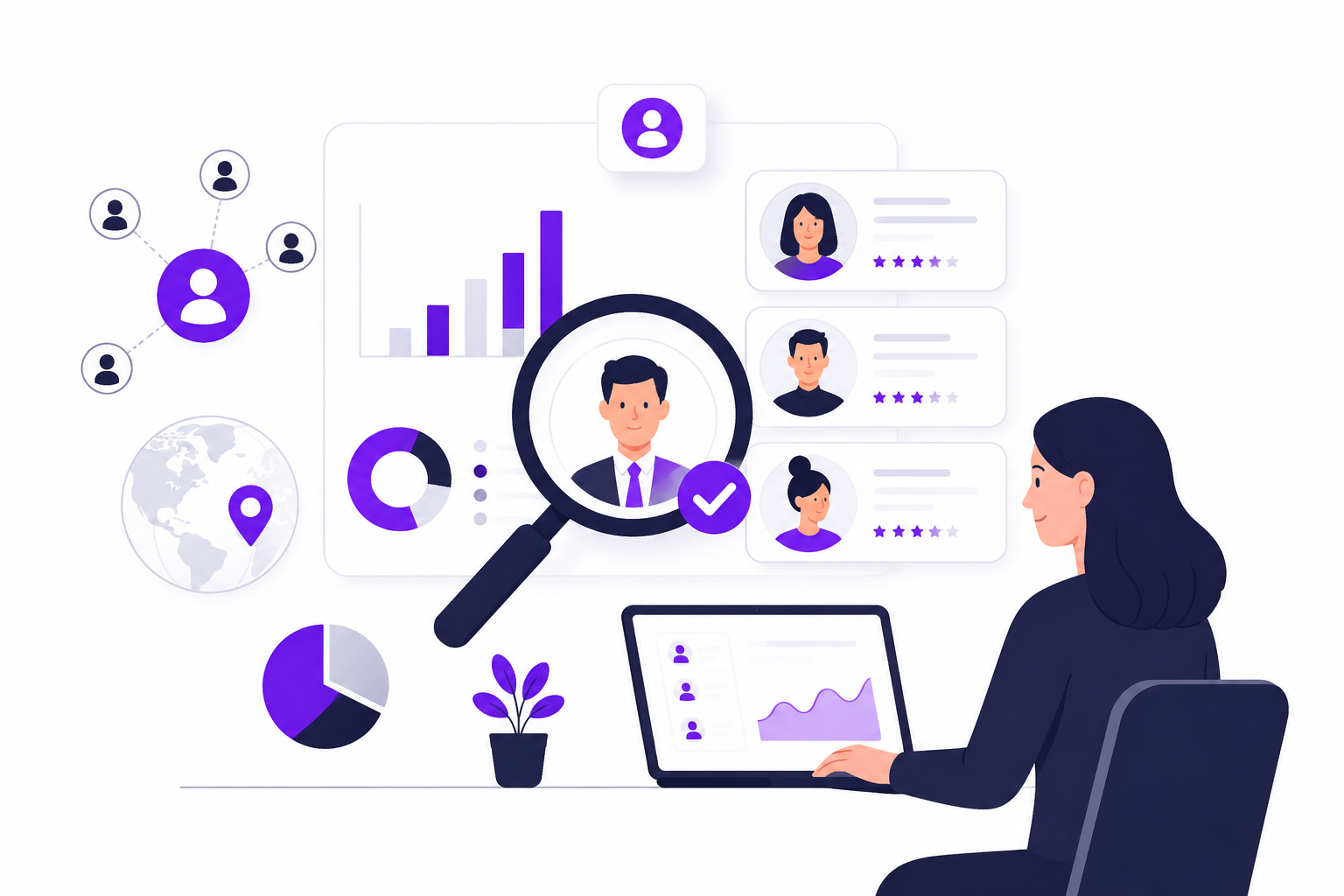
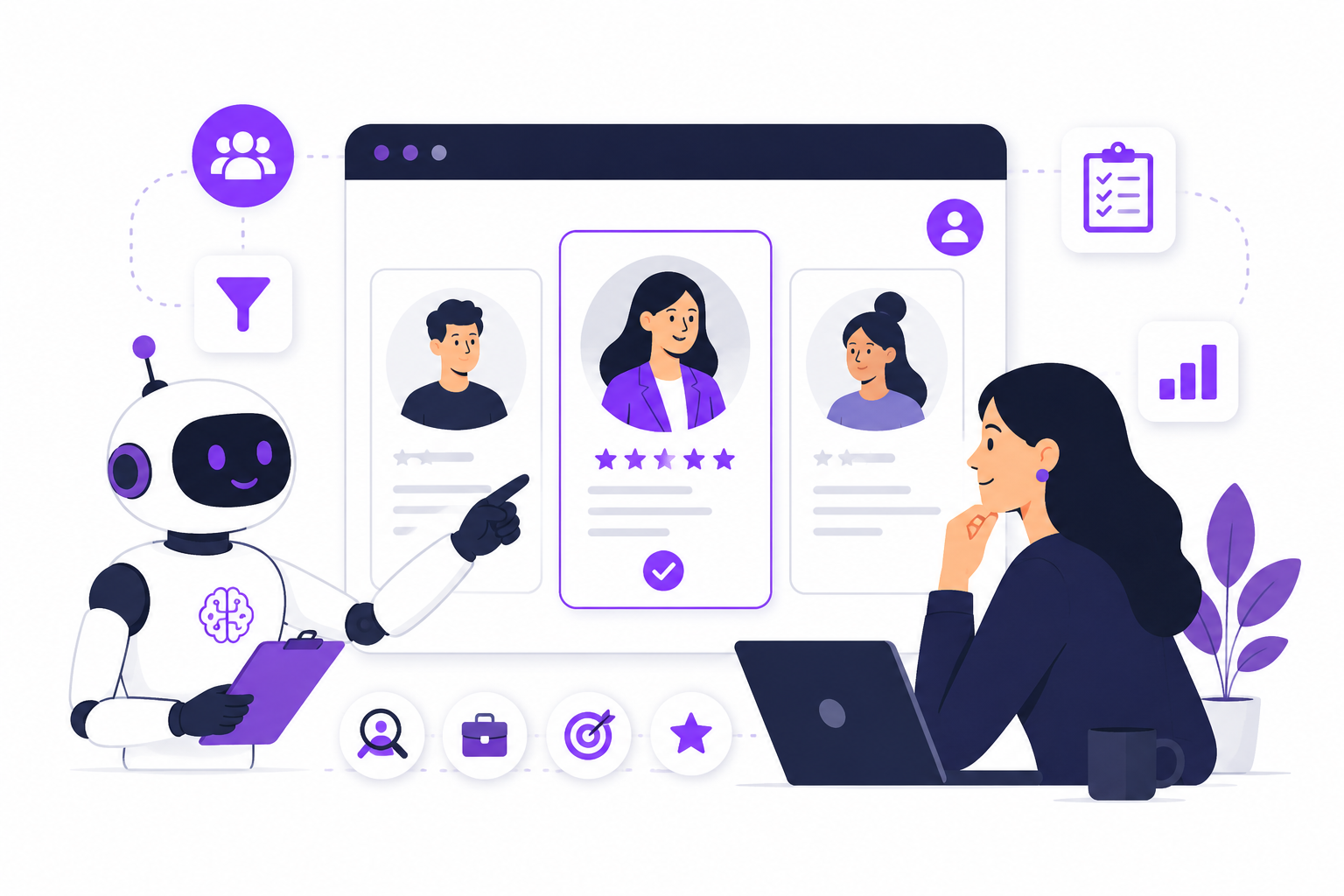
An AI recruiting platform is software that applies artificial intelligence to one or more stages of the hiring process, including sourcing, candidate matching, outreach, screening, scheduling, and conversion. The category includes everything from narrow point tools that automate a single step (say, resume parsing or interview scheduling) to end-to-end platforms that manage the full workflow from finding a candidate to filling a role.
The distinction matters because the market lumps both types together under the same label. A tool that sends automated follow-up texts is technically an AI-powered recruiting platform. So is a system that sources from 265 million enriched profiles, runs AI voice screening calls, scores candidates against open roles, and routes qualified candidates directly into your ATS. They are not the same thing, and evaluating them on the same criteria leads to bad purchasing decisions.
According to SHRM's 2025 Talent Trends data, 43% of organizations now use AI specifically in HR related tasks, up from just 26% in 2024, making it one of the most common AI applications. According to Boston Consulting Group, if a company is implementing AI, 70% of them are doing so within HR, and within HR, the top use of AI is in recruiting. Adoption is accelerating fast, which means the baseline expectation for what these tools should do is also rising quickly.
Key Features to Look for in an AI Recruiting Platform
Not every feature matters equally for every team. What a 20-person staffing agency needs from an AI recruiting platform is different from what a Fortune 500 TA team running high-volume seasonal hiring needs. That said, there are several capabilities that separate genuinely useful platforms from ones that will disappoint you six months in.
End-to-End Workflow Coverage
The biggest predictor of recruiting drop-off is the handoff between tools. When candidates go dark between outreach and screening or qualified leads sit uncontacted because no one owns the follow-up. Scheduling falls into email threads and never resolves. Each of these friction points is predictable and addressable, but only if your platform handles the full sequence rather than just one step of it.
Look for platforms that connect sourcing and matching with candidate engagement, qualification, and scheduling in a single workflow. The real gains come when AI tools integrate tightly with core talent systems and workflows, creating one coherent experience rather than a patchwork of disconnected platforms. If you are buying three separate tools and stitching them together with integrations, you are recreating the same drop-off problem in a different place.
AI Sourcing and Candidate Matching
Strong AI sourcing should let recruiters describe what they are looking for in plain language and surface qualified candidates from large, enriched talent databases without requiring Boolean expertise. The matching layer should score and rank candidates against your specific role requirements, not just return keyword hits.
Rediscovery is an underrated capability here. Most teams have significant untapped value in their existing ATS: previously engaged candidates, silver-medalists from past searches, placed workers who may be available again. A platform that can surface and rank those candidates against new openings is doing meaningful work that most teams currently handle manually, if at all.
Automated Candidate Engagement
Speed-to-contact is one of the most measurable variables in candidate conversion. CareerPlug's 2025 Candidate Experience Report found that 66% of candidates say a positive hiring experience directly influences their decision to accept an offer, and 26% rejected an offer specifically because of poor communication during the process. The teams winning on candidate experience are not necessarily the ones with the best brand or the highest pay, but rather the ones who respond faster and keep candidates informed throughout the process.
Automated engagement tools, including AI chat, SMS, and voice, handle the repetitive touchpoints that are easy to deprioritize when a recruiter is managing thirty open roles. Evaluate whether the engagement layer feels human enough to hold a real conversation, and whether it handles common candidate questions without requiring a recruiter to intervene.
AI Voice Screening
Voice AI for first-round screening is one of the highest-leverage capabilities currently available to recruiting teams. A well-built voice AI recruiter can conduct structured screening calls, validate candidate responses in real time, and pass only qualified candidates through to a human recruiter. AI-led scheduling reduces interview coordination time dramatically and the productivity gains from removing repetitive first-round screens from a recruiter's calendar compound significantly at scale.
The important evaluation criteria here are conversation quality (does it handle unexpected responses gracefully?), qualification accuracy (is it passing through the right candidates?), and bias risk (is the platform conducting regular audits on screening outcomes?).
ATS and VMS Integration
A platform that does not integrate cleanly with the tools your team already uses will generate adoption problems regardless of how good the AI is. Look for platforms with broad native integration support. Fifty or more ATS and VMS integrations is a reasonable benchmark in 2026. Also evaluate how the integration works in practice: does candidate data flow both ways, does it sync in real time, and does it preserve the candidate context your team has already built?
Analytics and Funnel Visibility
You cannot optimize what you cannot see. A good AI recruiting platform should give you visibility into where candidates are moving, where they are stalling, and what the conversion rates look like at each stage. Stage-level funnel analytics, recruiter productivity metrics, and time-to-fill tracking by role type and team are the baseline. If a platform cannot tell you where candidates are leaking out of your pipeline, it cannot help you fix the problem.
How AI Recruiting Platforms Speed Up Hiring
The speed gains from AI-based recruiting platforms come from two places: removing manual tasks from recruiters' plates, and compressing the time between hiring stages.
On the manual task side, the clearest wins are in sourcing, first-round outreach, scheduling coordination, and follow-up. Automated sourcing tools reduce time spent on top-of-funnel prospecting, and automated scheduling eliminates the back-and-forth that typically adds several days to every interview process.
The between-stage compression is less obvious but often larger in aggregate. Consider how long candidates currently sit in each status in your ATS. Applied but not yet reviewed. Reviewed but not yet contacted. Contacted but not yet screened. Screened but not yet scheduled. Each of those gaps represents time that AI automation can close, and in competitive talent markets, those are the gaps where you lose candidates to faster-moving competitors. The teams reducing time-to-hire are doing it through workflow automation, not by hiring more recruiters.
How to Measure ROI of an AI Recruiting Platform
ROI calculation for AI recruiting platforms is straightforward in theory and muddy in practice, mostly because teams rarely have clean baseline data before they start. Here is a framework that works even with imperfect starting data.
Establish Your Baseline Metrics
Before or immediately after implementation, capture the following numbers if you do not already have them: average time-to-fill by role type, number of qualified candidates submitted per recruiter per week, interview-to-offer ratio, offer acceptance rate, candidate drop-off rate by stage, and cost-per-hire.
You do not need all of these. Pick the three or four that your wants to prioritize the most and where you expect the platform to move the needle.
Measure Against Those Metrics at 90 Days
Ninety days is enough time to see meaningful signal without waiting so long that other variables have contaminated the data. Compare your baseline metrics to your current numbers. Pay particular attention to the stage-level metrics because they will tell you whether the platform is working where you expected it to and also whether there are unexpected gains or problems elsewhere in the funnel.
Calculate the Dollar Value of the Gains
Time-to-fill reduction is the most direct calculation: if a role pays $80,000 and you fill it 15 days faster, the productivity value of those 15 days is roughly $3,300. Multiply that across your total annual hires and the numbers get large quickly.
Recruiter productivity is the other major line item. If a recruiter who was managing 20 open roles can now manage 30 because automated tools are handling outreach, screening follow-up, and scheduling coordination, the capacity gain is real and calculable. Bullhorn reports that organizations are seeing 36% more placements per recruiter and a 22% higher fill rate with automation and AI, and that is the kind of ROI benchmark worth measuring any tool against.
Watch for Hidden Costs
Platform cost is only part of the equation. Factor in implementation time, the integration work required to connect the platform to your existing stack, and the training time for your recruiting team. Platforms that require heavy IT involvement to implement or significant ongoing maintenance will erode ROI faster than the headline price suggests.
Questions to Ask Your Team Before Choosing an AI Recruiting Platform
The best AI recruiting platform for your organization depends on where your current workflow is breaking down. Before you start evaluating vendors, get clear on the following.
Where are candidates currently dropping off?
If you lose most candidates between sourcing and first contact, your priority should be speed-to-contact and automated outreach. If you lose them between screen and schedule, your priority is scheduling automation and post-screen follow-up. The platform that solves your actual problem is more valuable than the one with the most features.
What does your team actually have capacity to adopt?
A platform with fifteen capabilities is only useful if your team uses them. Be honest about your current tech adoption maturity. Simpler, modular platforms that let you start with one workflow and expand naturally tend to outperform all-in-one systems that overwhelm teams at rollout.
How does this fit into your existing ATS and VMS?
Any platform that requires you to work outside your core system of record will create adoption problems. Confirm integration depth before you commit.
What are your compliance obligations?
NYC Local Law 144 requires employers using automated employment decision tools to conduct annual independent bias audits, publish the results publicly, and notify candidates before AI evaluates them, with penalties running up to $1,500 per violation per day. If you hire in regulated jurisdictions, your platform needs to support your compliance posture. Look for platforms that are certified compliant and have passed bias audits to ensure they have the adequate security and compliance metrics your business requires.
What does success look like in 90 days?
Agree on two or three specific, measurable outcomes before you start. Teams that define success criteria in advance are far more likely to achieve meaningful ROI than teams that implement and hope.
The Best All-in-One AI Recruiting Platform in 2026
For teams that want a single platform covering the full workflow from sourcing through filled roles, Curately is the most complete option currently available.
Curately is built around a three-pillar model: Find, Engage, Convert. The Find layer covers AI sourcing from a database of over 265 million enriched profiles and AI Match, which surfaces best-fit candidates from your existing ATS data. The Engage layer runs automated candidate conversations through voice AI (Maya, Curately's AI voice recruiter) and chat, handling outreach, FAQs, screening, and follow-up without requiring recruiter involvement at every step. The Convert layer handles qualification, routing, and scheduling so that candidates who complete the workflow arrive in a recruiter's calendar interview-ready.
What makes Curately different from most platforms in this category is that the workflow is seamlessly connected and integrated. Candidate context, conversation history, and qualification data persist across every stage, so there is no information loss between steps and no manual handoffs that create drop-off risk. Teams can also start with a single module, whether that is AI sourcing, voice screening, or candidate rediscovery, and expand the workflow end-to-end without replacing their existing stack or adding vendor relationships.
Curately integrates with over 50 ATS and VMS tools, which makes implementation practical for enterprise and staffing organizations that already have mature tech ecosystems. The platform has been adopted by Fortune 100 and Fortune 500 enterprises as a Gen 2 direct sourcing solution, often replacing incumbent providers that could not deliver measurable candidate conversion outcomes at scale.
For high-volume hiring teams specifically, the combination of AI sourcing, automated engagement, and voice screening handles the throughput demands that manual processes cannot scale to meet. Curately's ability to reduce time-to-first-contact to less than 1 minute and save over 7 hours per recruiter, per week, makes it a perfect for teams in industries where hiring speed and volume are critical. For enterprise talent acquisition and direct sourcing programs, the AI Match and talent community activation capabilities mean that owned talent pipelines generate real fills rather than sitting as expensive, underutilized databases.
Conclusion
The AI recruiting platform market in 2026 has genuinely useful technology in it, and it also has a lot of tools that automate the easy parts of recruiting while leaving the hard parts exactly as they were. The teams getting real results are the ones who started with a clear picture of where their workflow was breaking down, chose a platform that addressed that specific problem, and measured outcomes rigorously enough to know whether it was working.
The features that matter most are end-to-end workflow coverage, strong AI sourcing and matching, automated candidate engagement that moves fast enough to compete for talent, and clean integration with the systems your team already uses. ROI is real and measurable, but it requires honest baseline data and genuine adoption.
If you are evaluating platforms and want to see what a connected workflow that enhances the recruitment process from "find" to "filled" looks like in practice, you can learn more here.
FAQ
1. How do AI recruiting platforms help reduce candidate drop-off during hiring?
AI recruiting platforms reduce candidate drop-off by automating follow-up communication, speeding up candidate outreach, simplifying interview scheduling, and keeping applicants informed throughout the hiring process. Features like AI chat, SMS engagement, and voice AI screening help maintain fast and consistent communication, which improves candidate experience and increases conversion rates.
2. Are AI recruiting platforms worth the investment for staffing agencies and enterprise hiring teams?
For many staffing firms and enterprise talent acquisition teams, AI recruiting platforms deliver measurable ROI by improving recruiter productivity, reducing time-to-fill, increasing candidate engagement, and automating repetitive workflows. Organizations using AI recruiting automation often see recruiters manage more open roles while maintaining faster hiring cycles and better candidate experiences.
3. What should companies evaluate before choosing an AI recruiting platform?
Before selecting an AI recruiting platform, companies should evaluate workflow coverage, AI sourcing quality, ATS and VMS integrations, automation capabilities, analytics visibility, compliance support, and ease of adoption for recruiting teams. It is also important to identify where candidates currently drop off in the hiring funnel so the platform solves the organization's biggest recruiting bottlenecks.