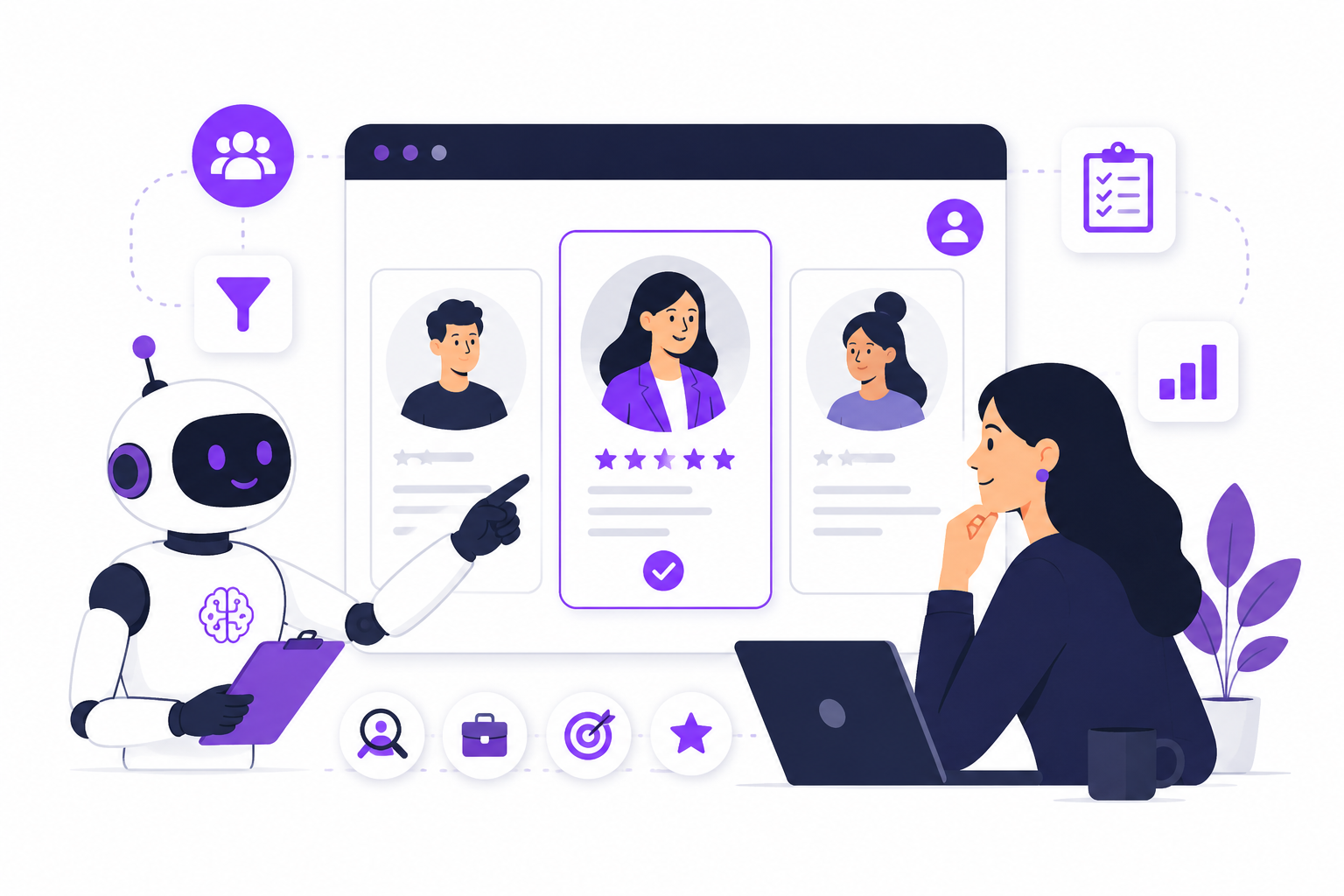

If you have ever posted a job and watched forty unqualified resumes roll in while the perfect candidate for that role was sitting quietly on LinkedIn, three companies away, not even looking for a new job, you already understand why sourcing matters.
Recruiting has changed. Waiting for applications to trickle in is no longer a strategy; it is a bottleneck. The teams that consistently hire well are the ones that go find talent instead of waiting for it to find them. This guide breaks down what candidate sourcing actually means, where it is headed in 2026, the numbers behind it, and what you can practically do to get better at it.
What is Candidate Sourcing?
Candidate sourcing is the practice of proactively identifying and reaching out to potential candidates, including people who are not actively applying to jobs. It happens before a job posting ever goes live, and often before a recruiter even knows exactly who they are looking for.
This is different from recruiting in the broader sense. Recruiting covers the full hiring journey, from the first conversation to the signed offer letter. Sourcing is specifically the "finding" part. Think of it as building the pool that the rest of your hiring process draws from.
Here is a scenario most recruiters will recognize. You post an opening for a senior engineer. Within a week, you have ninety applications. You spend two full days screening them and end up with three people worth a phone call, and none of them get an offer. Meanwhile, the engineer who would have been perfect for the role never saw the posting because they were happily employed and not scrolling job boards.
That is the gap sourcing is meant to close. Instead of relying only on people who happen to apply, sourcing involves actively searching platforms like LinkedIn, GitHub, niche community boards, and your own applicant database to find people who match the role, whether or not they are currently looking.
Sourcing methods generally fall into two buckets:
- Traditional methods: job postings, referrals, networking events, cold calling, and manual Boolean searches.
- Modern methods: social media search, talent acquisition platforms, AI-assisted matching, and automated outreach across multiple channels at once.
Most recruiting teams use a mix of both. The traditional methods still work, but they do not scale. This is where automated and AI-powered sourcing has become a bigger part of the conversation, since it lets a small team cover far more ground than manual searching ever could.
Candidate Sourcing Trends 2026
A few shifts are shaping how sourcing actually gets done this year.
Sourcing is moving from search to matching: For years, sourcing meant typing long Boolean strings into a search bar and hoping the right keywords surfaced the right people. That is changing. Tools now take a job description, an intake call transcript, or even a description of your best past hire, and return a ranked list of people who fit that profile. The recruiter's job shifts from digging through hundreds of results to reviewing a short, relevant list.
Quality is beating quantity: A list of eight strong, well-matched candidates is worth more than a list of eight hundred loosely related ones. Recruiting teams are realizing that a larger database does not automatically lead to better hires. What matters is precision, meaning does the tool actually understand the role and the kind of person who succeeds in it.
Passive candidates already in your system are getting a second look: Most companies have thousands of past applicants sitting in their ATS who were never a fit for the role they applied to, but might be perfect for something open right now. Rediscovering these candidates is faster and cheaper than starting a search from scratch, and more teams are building this into their sourcing process rather than treating their own database as a dead archive.
Skills are starting to matter more than resumes: According to workforce research on hiring trends, the share of US employers using skills-based hiring rose from 57% in 2022 to 73% in 2023 and 81% in 2024. That trend is bleeding into sourcing, too. Instead of filtering candidates by job titles and years of experience, sourcing tools are increasingly evaluating what someone can actually do.
Candidate trust in AI is not keeping pace with adoption: This is the trend worth paying attention to. Even as companies rush to adopt AI sourcing tools, surveys consistently show that only about one in four candidates trust AI to evaluate them fairly, and a meaningful share of job seekers say they would think twice about applying to a company they know uses AI in the hiring process. Sourcing faster does not mean much if candidates feel like they are being processed rather than considered.
Integration is the deciding factor, not the search itself: A tool that finds great candidates but does not push that data into your ATS or CRM just creates a second system for recruiters to manage. Teams are now judging sourcing tools less on "how many profiles can it search" and more on "how much manual work does it save me after it finds someone."
Candidate Sourcing Stats You Should Know
Numbers tell the story better than opinions do. Here is what the current data says about sourcing, AI adoption, and the state of hiring in 2026.
On AI adoption in sourcing and screening:
- According to SHRM, 40% of companies use AI to screen and assess candidates, 41% use AI-powered chatbots to engage job seekers, and 44% use AI to identify talent from social media profiles.
- Aptitude Research found that 63% of companies are investing or planning to invest in AI recruiting solutions, up from 42% in 2020.
- One industry survey found that 78% of recruiters say AI accelerates candidate sourcing to a meaningful degree.
On time and cost:
- Multiple industry reports on recruiting automation indicate that intelligent sourcing tools cut recruiters' sourcing time by roughly 30%.
- Some organizations using AI-powered recruiting tools have reported time-to-hire reductions of up to 70%, alongside cost-per-hire reductions of around 30%.
- Recruiting teams that use AI consistently throughout the hiring process, not just for one-off tasks, report completing significantly more candidate screens per week than those using it sparingly.
On the talent shortage driving sourcing demand:
- Roughly three-quarters of businesses report ongoing difficulty finding qualified talent, according to recent workforce research.
- LinkedIn Talent Solutions research found that 46% of talent acquisition leaders say attracting qualified candidates has become consistently difficult.
- In one survey of talent leaders, 70% named building a strong, proactive talent pipeline as their top hiring priority.
On candidate trust and experience:
- Surveys consistently find that only about 26% of candidates trust AI to evaluate them fairly.
- A significant share of job seekers, in some surveys as high as two-thirds, say they would hesitate to apply for a role if they knew AI played a role in the hiring decision.
- Referral hires remain disproportionately valuable. Referrals typically make up a small share of total applicants, often cited at around 7%, but account for closer to 30% of actual hires.
On the labor market itself:
- U.S. Bureau of Labor Statistics data show the workforce is several million people below pre-2020 levels, contributing to a market where open roles outnumber active job seekers.
- World Bank projections suggest the working-age population (15 to 65) will shrink in the U.S. by more than 3% over the coming decade, a structural reason why sourcing, not just posting jobs, will keep growing in importance.
The pattern across all this data is consistent: demand for sourcing automation is rising as the talent pool tightens, but candidate skepticism about AI is rising right alongside it. Both things are true at once, and any sourcing strategy in 2026 needs to plan for both.
Benefits of Automated Candidate Sourcing
When sourcing automation is set up well, the benefits show up in ways recruiters feel almost immediately.
You get your time back. Manual sourcing eats hours that could go toward actually talking to candidates. Automating the repetitive parts, like searching, filtering, and initial outreach, frees recruiters to focus on the conversations that actually move a hire forward.
You reach people who were never going to apply. Passive candidates make up the majority of the workforce at any given time. Automated tools that scan multiple platforms and your own historical database surface people who would never have seen your job posting otherwise.
Your process gets more consistent. When the same criteria are applied to every candidate, you naturally reduce the kind of inconsistent, subjective judgment calls that lead to bias. This does not eliminate bias entirely, but it does create a more defensible, repeatable process.
Hiring speeds up. A recruiter who used to spend a full day building a longlist can now review an AI-ranked shortlist in under an hour. That speed matters more than most teams realize, since top candidates are often gone from the market within a couple of weeks.
Data starts working for you instead of sitting unused. Automated sourcing tools track what is happening across your pipeline: which channels produce the best candidates, which messages get replies, where people drop off. That visibility lets you actually fix the parts of your process that are underperforming, rather than guessing.
Here is a simple way to think about the return on this. If a recruiter saves even five hours a week by not manually searching and copy-pasting outreach messages, that is more than 250 hours a year that go back into interviewing, relationship-building, and closing candidates faster than the competition.
Common Challenges in Candidate Sourcing
None of this comes without friction. A few challenges recur for recruiting teams adopting sourcing automation.
There simply are not enough qualified candidates. In surveys of in-house recruiting teams, scarcity of qualified candidates is consistently cited as the number one sourcing challenge, ahead of diversity goals or demand forecasting. Automation helps you search faster, but it cannot manufacture talent that does not exist in the market.
Candidates do not fully trust the process. This is the challenge that gets talked about the least but matters the most. If a candidate senses they are being sourced and screened entirely by algorithms with no human involvement, some will simply disengage. The data backs this up: trust in AI-driven hiring decisions remains low even as adoption climbs.
Tools that do not talk to each other create more work, not less. A sourcing tool that returns a great list of candidates but requires manual re-entry into your ATS solves one problem and creates another. Many HR teams report struggling to connect new automation tools to their existing systems.
Bias does not disappear on its own. Algorithms trained on biased historical data can quietly repeat old patterns of who gets noticed and who does not. Any automated sourcing tool needs regular auditing, not a one-time setup-and-forget approach.
Over-reliance can backfire. When a team leans on automation for every part of sourcing, including the human judgment calls, quality can slip. A tool can rank candidates by fit, but it cannot read the nuance in a conversation the way an experienced recruiter can.
Data privacy is now a real compliance issue, not a footnote. With regulations like the EU AI Act placing new obligations on AI used in hiring, and local laws in places like New York City requiring bias audits for automated employment tools, sourcing automation has moved from a "nice-to-have" feature list to something legal and compliance teams need to sign off on.
A recruiter I think about often described it this way: automation solved her volume problem but created a trust problem. She could source three times as many candidates, but candidates who felt "processed" rather than personally reached out to were less likely to respond. The lesson there was not to source less. It was to source smarter and keep the human touch in the outreach itself.
Top AI Sourcing Tools and Platforms
Cross-platform aggregator tools: These search across dozens of sources at once, including LinkedIn, GitHub, portfolio sites, and niche community boards, and combine everything into a single searchable database. They are strong at reaching candidates who are not active on the usual job boards, particularly in technical or specialized fields.
Agentic sourcing assistants: These take a job description, an intake call, or a "find me someone like this person" input and automatically return a ranked shortlist, without the recruiter writing a single Boolean string. The strength here is speed and reduced manual search time. The thing to watch for is how the tool ranks candidates: is it matching against generic skills keywords, or against the actual pattern of who has succeeded at your company in similar roles?
Curated, done-for-you sourcing services: These combine AI screening with a human review layer, delivering a pre-vetted shortlist straight to your inbox. They work well for lean teams that need to fill a pipeline quickly without staffing a dedicated sourcer, though you trade some in-house calibration and control for that convenience.
Passive candidate rediscovery tools: Mine your own ATS or CRM for past applicants who match a currently open role. This is often the fastest and cheapest sourcing win available, since you already have some relationship with these candidates and do not need to search externally.
Natural language search tools: Instead of Boolean strings with "AND," "OR," and "NOT" operators, these let a recruiter describe a candidate in plain language, the same way they would describe them to a colleague, and the system interprets that into a search.
Whatever category you are evaluating, a useful checklist to run any tool through:
- Does it capture data automatically (emails, social links, touchpoints) instead of requiring manual entry?
- Can you segment candidates into talent pools for more relevant, personalized outreach?
- Does it support bulk, templated outreach without sacrificing personalization?
- Can you set up follow-up reminders and nurture sequences for candidates who are not yet ready?
- Does it give you real search and filtering across your own database, not just external sources?
- Does it integrate cleanly with your ATS, CRM, and email, so results do not live in a silo?
- Does it give you reporting on outreach performance, not just candidate volume?
At Curately.ai, this is the exact conversation we have with recruiting teams before they ever touch a tool. The question is never "how many profiles can this search?" It is "how much of my week does this actually give back, and does it fit into the systems I already use?"
How To Improve Candidate Sourcing with AI (Practical Steps)
If you want to actually get better results from AI-assisted sourcing rather than just adding another tool to your stack, here is a practical sequence that works.
1. Fix your intake before you touch any tool. Most bad sourcing results trace back to a vague brief. Run a structured intake conversation with the hiring manager. Pin down the actual must-haves versus the nice-to-haves, what success in the role looks like, and how candidates will be evaluated. Whatever AI tool you use is only as good as the brief you feed it.
2. Let AI handle the first pass, not the final call. Use AI to generate the initial shortlist from your brief, a past successful hire, or a job description. Most teams can get a ranked list of ten to twenty candidates in a matter of minutes this way. The recruiter's job is to review, not to search from scratch.
3. Rank candidates against your own hiring history, not generic keywords. A tool that matches against a skills taxonomy will return technically "qualified" people. A tool that weighs candidates against those who have actually succeeded at your company in similar roles will return people far more likely to be the right fit. This distinction matters more than almost anything else in the sourcing process.
4. Personalize outreach, but keep a human reviewing it. AI can draft outreach messages grounded in the specific brief and a candidate's public background. That said, always have a recruiter read and adjust before sending. Given how skeptical candidates are of fully automated hiring processes, a message that feels genuinely personal is worth the extra thirty seconds.
5. Push everything back into your ATS. Manual re-entry of candidate data is one of the highest hidden costs of sourcing tools that do not integrate. If a tool cannot write candidate information directly into your existing system, you are creating administrative work instead of removing it.
6. Track what is actually working. Look at reply rates, time-to-shortlist, and which sourcing channels produce candidates who make it to the offer stage. Without this data, you are guessing at what to improve next.
7. Keep a human checkpoint at every important decision. Use AI to widen the funnel and speed up the early stages. Keep humans firmly in charge of interviews, final evaluations, and any decision that meaningfully affects a candidate's future. This is not just good practice; it is increasingly a compliance requirement and also what keeps candidates from feeling like they were hired by an algorithm.
A good test for any AI sourcing setup: pick a genuinely hard-to-fill role, run it through the tool, and measure recruiter time-to-shortlist rather than list length. The tool that gets you to a shippable, high-quality shortlist fastest is the one worth keeping.
Sourcing has always been about one thing: finding the right person before your competitor does. AI and automation have not changed that goal; they have just changed how fast and how far a recruiting team can reach while still doing it well. The teams that will win the talent they need in 2026 are the ones pairing that speed with the human judgment that candidates still expect and still deserve. That balance is exactly what we spend our time helping recruiting teams build at Curately.ai.
FAQs on Candidate Sourcing
What is candidate sourcing? Candidate sourcing is the process of proactively identifying and engaging potential candidates for a role, including those not actively job hunting. It happens before applications come in and is the foundation that the rest of recruiting builds on.
What is automated candidate sourcing? Automated candidate sourcing uses software and AI to handle the repetitive parts of finding candidates, such as searching multiple platforms, filtering by criteria, and initiating outreach, so recruiters do not have to do it all manually. The recruiter still reviews and makes the final calls, but the heavy lifting of the search happens automatically.
What is AI candidate sourcing, specifically? AI candidate sourcing goes beyond basic automation. Instead of just running a search based on fixed filters, AI tools interpret a job description or brief, weigh candidates by genuine fit, and return a ranked list with reasoning attached. It is the difference between a keyword filter and a system that actually understands what "good fit" means for a specific role.
How do you implement automated candidate sourcing? Start by mapping your current sourcing process and identifying where most time is lost, typically in manual searches or repetitive outreach. Choose a tool that integrates with your existing ATS and CRM, pilot it on one or two open roles, and measure results against your current process before rolling it out team-wide.
How do you automate candidate sourcing with AI? The short version: build a clear intake brief, feed it into an AI sourcing tool, review the ranked shortlist it returns, personalize the outreach it drafts, and make sure the results sync back into your ATS. Each of these steps should reduce manual work, not add a new tool to babysit.
What AI tools help with candidate sourcing? There is no single "best" tool, since it depends on what you need. Cross-platform aggregators are best for reaching passive or hard-to-find talent. Agentic sourcing assistants are best for turning a brief into a fast, ranked shortlist. Curated sourcing services work well for lean teams without a dedicated sourcer. Passive candidate rediscovery tools are the fastest win if your ATS already has years' worth of applicants sitting unused.
Does AI sourcing replace recruiters? No. AI sourcing removes repetitive searching and filtering, but judgment calls, understanding cultural fit, negotiating, and building genuine relationships with candidates still belong to the recruiter. The teams getting the best results treat AI as a way to broaden and accelerate the top of the funnel, not as a replacement for human decision-making.