Ask any recruiting team and they'll tell you: generally, they don't struggle with finding candidates, they struggle with finding the right candidates at the right time.
Roles open, and suddenly it's a scramble. Recruiters go back to job boards, dig through old resumes, spin up new sourcing efforts, and try to rebuild momentum under pressure. It's a cycle that repeats itself across teams and industries, and over time, it creates a hiring process that feels reactive and unpredictable.
Talent pipeline management exists to break that cycle.
Instead of starting from zero every time a role opens, it allows teams to build a system where candidates are already identified, already engaged, and often already interested.
In this guide, we'll break down:
- What a talent pipeline actually is
- How pipeline management works in practice
- How to build and maintain a strong pipeline
- Common challenges and how to fix them
- Metrics that matter
- How AI sourcing tools are changing pipeline recruiting
If you want to move from reactive hiring to something more structured and predictable, this is where that shift begins.
What Is Talent Pipeline and Why Is It Important?
A talent pipeline is a structured, actively managed system that allows recruiting teams to identify, engage, and track talent over time (often before a role even exists).
In practice, a strong pipeline means you already know who your next hire could be. You've seen their experience, had initial conversations, and understand what might motivate them to make a move. Instead of scrambling when a role opens, you're starting from a position of familiarity and momentum.
This is where talent pipeline management becomes critical. Without it, even experienced recruiting teams fall into reactive patterns: posting jobs, waiting for applicants, and repeating the same sourcing effort every time. Over time, this creates inefficiencies that compound: longer hiring cycles, higher sourcing costs, and inconsistent candidate quality.
With a well-managed pipeline, these pitfalls can be avoided. Hiring becomes less about urgency and more about readiness. Hiring teams can focus on building a system that supports ongoing hiring needs with less friction and more predictability.
Talent Pool vs Talent Pipeline
These two terms are often confused, but the difference matters.
A talent pool is a curated collection of candidates for a particular role. It might include new applicants, past applicants, or sourced profiles.
A talent pipeline is the broader system that organizes, tracks, and moves candidates through different stages of the hiring process over time. It may include multiple talent pools, engagement history, and progression toward hiring.
Key Stages of Talent Pipeline Management
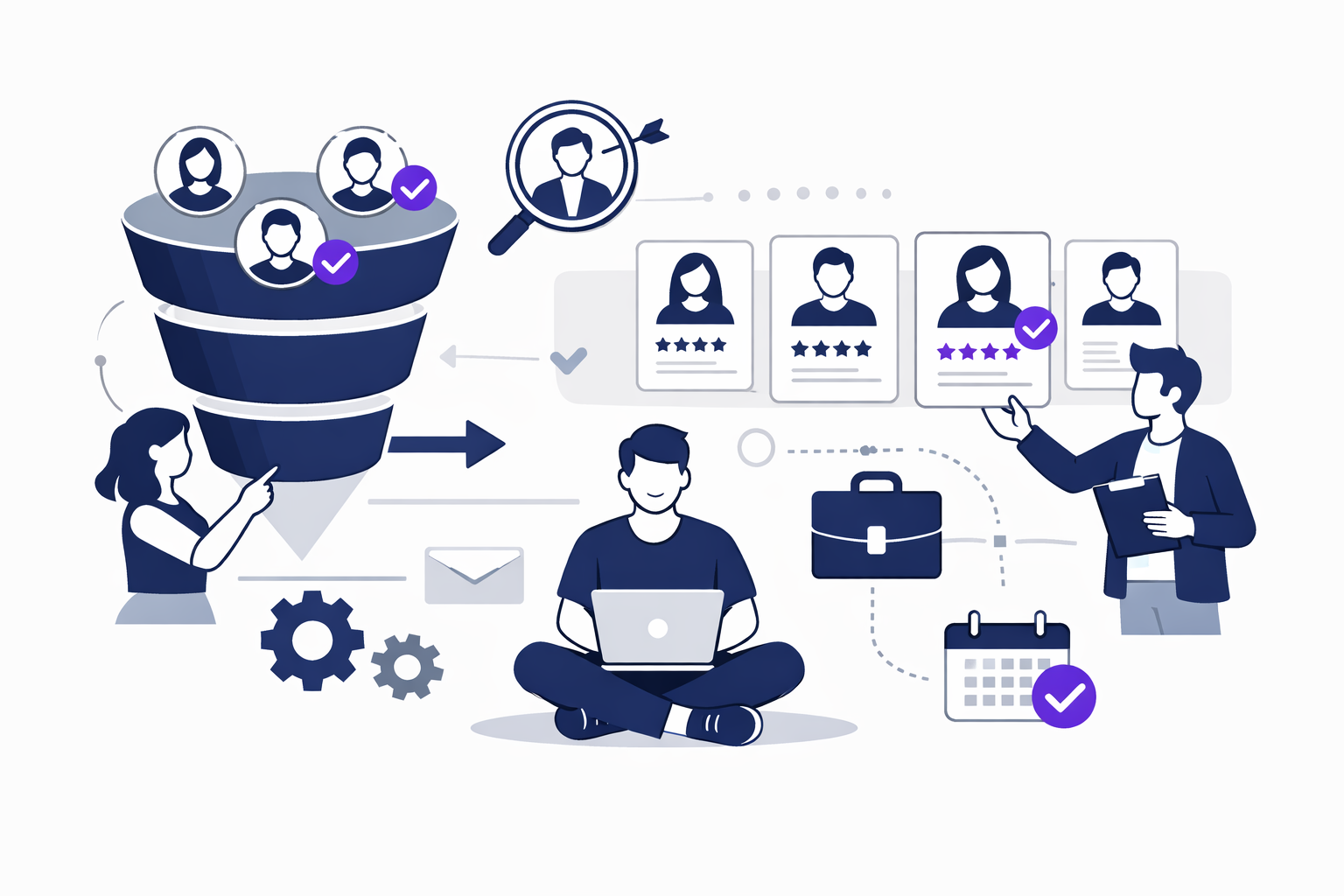
While different organizations label pipeline stages differently, the most effective recruiting teams treat pipeline management as a continuous lifecycle rather than a linear funnel. Candidates move in and out of readiness depending on timing, interest, and opportunity. That means your pipeline isn't something you "build once" but something you continuously refine, expand, and activate.
1. Sourcing and Identification
This is where candidates first enter the pipeline.
It includes direct sourcing, referrals, past applicants, and inbound interest. But strong teams focus less on volume and more on relevance. Adding 500 candidates who are loosely qualified is far less valuable than adding 50 who actually align with future hiring needs.
2. Qualification and Segmentation
Once candidates enter the pipeline, the next step is making that data usable. This is where many pipelines break down. Without proper segmentation, even a large pipeline becomes difficult to navigate.
Strong teams group candidates based on role fit, seniority, skill clusters, geographic preferences, and even engagement level. For example, a candidate who is "open to opportunities in the next 3–6 months" should be treated very differently from someone actively interviewing.
This level of organization allows recruiters to quickly identify who to engage when a role opens, instead of manually reviewing hundreds of profiles.
3. Engagement and Nurturing
Engagement is what turns a pipeline into something valuable. Without it, even the best candidate list becomes outdated quickly.
Most candidates in a pipeline are not ready to move immediately. They may be satisfied in their current role, waiting for the right opportunity, or simply not actively thinking about a change. That means recruiting teams need to shift from closing to staying relevant.
This doesn't require constant messaging. In fact, over-communication can backfire. What works better is thoughtful, periodic engagement: sharing relevant updates, checking in at the right time, or simply maintaining a light connection. Over time, this builds familiarity, which significantly increases response rates when a real opportunity arises.
4. Activation
When a role opens, this is where pipeline work pays off.
Instead of starting fresh, recruiters can immediately identify candidates who are already familiar with the company and potentially interested. Outreach becomes faster, conversations are warmer, and timelines compress significantly.
5. Conversion and Hiring
Because relationships already exist, conversion rates tend to be higher. Candidates are not being introduced to the company for the first time but are merely continuing an existing conversation.
How to Build a Talent Pipeline
Building a talent pipeline is often misunderstood as a sourcing exercise. In reality, sourcing is only the entry point. What separates high-performing recruiting teams is how they organize, engage, and maintain those relationships over time.
A pipeline that is built but not maintained quickly loses value. The goal is to create a system that makes future hiring faster and more predictable.
Start with High-Volume or Repeat Roles
Focus first on roles that appear consistently. These are where pipeline investment pays off fastest.
Use Multiple Sourcing Channels
A resilient pipeline pulls from multiple sources: direct sourcing, referrals, inbound applicants, and past candidates. Relying on a single channel limits coverage.
Build Relationships Early
One of the biggest mindset shifts in pipeline recruiting is timing. Many recruiters wait until a role opens before reaching out, but by then, they're competing with other companies that may already be engaging the same candidate.
Reaching out early changes that dynamic. Even a short introductory conversation can create a foundation for future engagement. You learn what the candidate cares about, what might trigger a move, and when they might be open to change.
Keep the Pipeline Active
Pipelines require maintenance. Without regular updates and engagement, they become stale quickly.
Common Challenges in Talent Pipeline Management
Even teams that understand pipeline recruiting struggle with consistency. The following problems are common, but can be avoided with the right strategies and execution:
Pipelines That Go Stale
Candidates change jobs, priorities shift, and timelines move. Without regular touchpoints, pipelines lose relevance.
Lack of Engagement
A pipeline without communication is just a database. Engagement is what gives it value.
Recruiter Bandwidth
Pipeline management often competes with urgent hiring needs. When roles are open, recruiters focus on immediate priorities, and pipeline work gets deprioritized.
This is where process and tooling matter. Without structure, pipeline efforts become inconsistent.
Metrics to Measure Talent Pipeline Success
Metrics are what separate a pipeline from a guess.
Many teams build pipelines but don't measure whether they actually contribute to hiring outcomes. Without visibility, it's difficult to improve.
Strong pipeline metrics focus on effectiveness, not just size:
- Conversion rates from pipeline to hire
- Time-to-fill using pipeline candidates
- Engagement rates
- Pipeline coverage across roles
These metrics show whether your pipeline is something you can rely on—or just something you've built.
AI Sourcing Tools in Talent Pipeline Management
As pipelines grow, manual management becomes increasingly difficult.
Reviewing profiles, updating candidate status, tracking engagement, and identifying matches all require time. At scale, this becomes unsustainable without support.
AI sourcing tools change that dynamic. Let's be clear: they don't replace recruiters. Instead, they reduce the manual effort required to keep pipelines accurate, active, and useful.
How Curately Enhances Talent Pipeline Management
What makes Curately different is how it connects sourcing, engagement, and pipeline management into a single continuous workflow.
Instead of treating these as separate activities, recruiters can move from identifying candidates to engaging them to activating them for open roles without switching tools or rebuilding searches.
Curately enables:
- Natural language sourcing instead of Boolean keyword searches
- Intelligent candidate matching across skills and roles
- Automated engagement through Curately's AI voice agent Maya
- Continuous pipeline updates and recommendations
The result of these differentiators is a pipeline that stays usable.
Conclusion
Talent pipeline management is ultimately about shifting how recruiting teams think about time.
Reactive hiring compresses everything into the moment a role opens. Pipeline-driven recruiting spreads that effort out, allowing teams to build relationships, gather insights, and prepare in advance.
Teams that invest in pipeline management don't rely on urgency to drive results. They create systems that make hiring more predictable, more scalable, and less dependent on last-minute effort.
As hiring demands grow and candidate expectations evolve, this approach becomes less of an advantage and more of a requirement.
The question is no longer whether to build a pipeline; it's whether your pipeline is something you can actually use when it matters.
Frequently Asked Questions
What is talent pipeline management?
Talent pipeline management is the process of building, organizing, and maintaining a pool of candidates who can be engaged and hired for future roles.
How do you build a talent pipeline?
You build a talent pipeline by sourcing candidates, organizing their data, engaging them over time, and maintaining relationships until roles open.
What is the difference between a talent pool and a talent pipeline?
A talent pool is a curated group of candidates associated with a specific role or hiring need, often built through sourcing efforts and continuously updated as new candidates are added. In modern systems like Curately, talent pools are dynamic and actively managed, rather than static lists.
A talent pipeline, on the other hand, is the broader system that organizes, tracks, and moves candidates through different stages of the hiring process over time. It includes multiple talent pools, engagement history, and progression toward hiring.
In simple terms: A talent pool is a collection of candidates for a role, while a talent pipeline is the end-to-end process used to manage and convert those candidates into hires.
Why is talent pipeline management important?
It helps reduce time-to-hire, improve candidate quality, lower recruiting costs, and create a more predictable hiring process.