If you have ever opened your applicant tracking system and felt your stomach drop at the number sitting in the "new applications" folder, you already understand the problem this guide is about.
Zapier's head of talent shared a number in a recent interview that says a lot about where recruiting is right now. Her team gets around 500 applications a day. About 499 of them look perfect on paper. Candidates now use AI to polish their resumes until almost every application reads like a strong match, which makes it nearly impossible to tell who is actually right for the role just by reading it.
This is not a story about robots taking over recruiting. It is a story about recruiters trying to find real signal in a flood of noise, and needing better tools to do it.
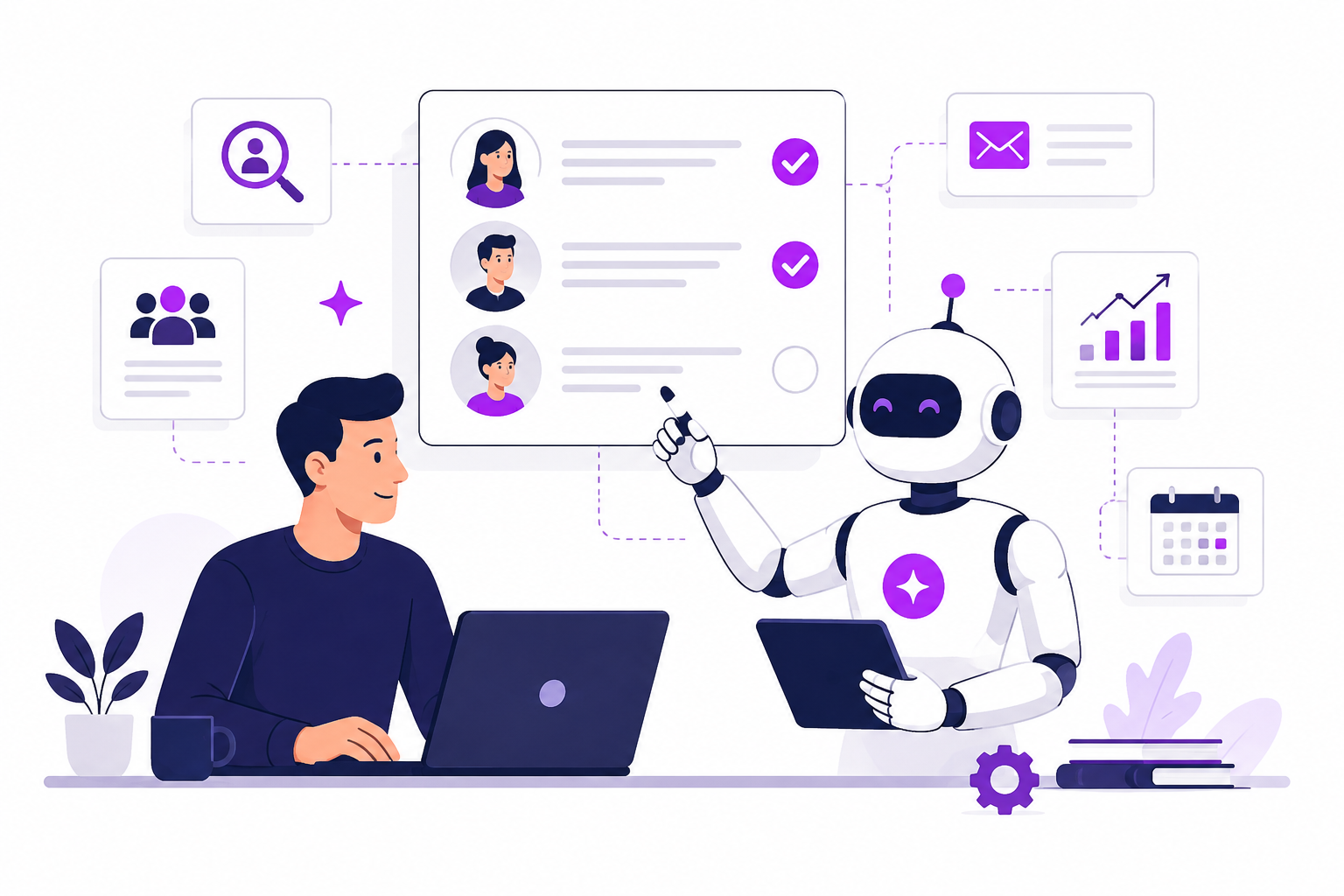
Agentic AI is one of those tools. In simple terms, it is software that can take a hiring goal, like building a shortlist or getting a candidate to a scheduled interview, and carry out the steps to get there on its own. It checks in with a person at the moments that matter. It does not replace judgment. It clears away the repetitive work that stands between a recruiter and that judgment.
This guide is written for recruiters, talent acquisition leaders, and HR ops managers trying to figure out where this technology actually helps and where it does not. We will cover what agentic AI is, how it works stage by stage in a real hiring process, where it genuinely breaks down (fraud, bias, and a few technical blind spots included), and how to roll it out without disrupting everything your team already relies on.
What Is Agentic AI?
Before getting into recruiting specifically, it helps to understand what agentic AI actually means, because the term gets used loosely.
Here is the simplest way to think about it. A generative AI tool works like a calculator. You give it an input, it gives you an output, and it stops. Ask it to write a job description, and it writes one. Ask it a question, and it answers. It does nothing else unless you ask again.
Agentic AI works more like a GPS. It does not just wait for your next instruction. It looks at the situation in front of it, decides what needs to happen next, takes that step, and reassesses. If traffic changes, it reroutes without you telling it to.
That difference matters because it changes what these tools can actually take off your plate. A generative tool can draft an email for you. An agentic one can decide who needs an email, write it, send it, and follow up if nobody replies, all without you sitting there directing each step.
A handful of traits define an agent, and none of them require a technical background to understand:
- It takes initiative instead of waiting to be prompted.
- It can act inside other software, not just answer questions about it.
- It adjusts its approach when something changes.
- It gets better over time based on what worked and what did not.
One thing worth saying clearly here, because a lot of the hype around this topic skips it: agentic AI is not the same thing as a smarter chatbot, and it is also not full autonomy with no human involved anywhere. People who actually build these systems for a living will tell you the same thing. We are not at the point of a fully autonomous hiring team that runs itself with zero human oversight, and honestly, we should not want to be. The technology has real gaps, and pretending otherwise does not help anyone make a good decision about it.
A quick example that has nothing to do with hiring helps make this concrete. A few years back, Google demonstrated an AI assistant that could call a restaurant and book a table on its own. It had a goal (get a reservation), broke that goal into steps (find the number, make the call, agree on a time), carried out those steps, and added the reservation to a calendar. Nobody walked it through each individual step. That is the basic shape of what an agent does, just applied to a much simpler task than hiring.
What Is Agentic AI in Recruiting?
Now let's bring this back to hiring, because "agentic AI" as a general idea and "agentic AI in recruiting" are not quite the same conversation.
In a hiring context, agentic AI is software that can take a specific goal, like "build me a shortlist for this role" or "get this candidate to a scheduled interview," and carry out the string of actions needed to get there. It searches, it reaches out, it follows up, it schedules. It pauses and checks in with a person at the points where a decision actually matters.
It is worth being honest about where this technology actually stands today, instead of overselling it. Sourcing, building a shortlist, sending follow-up messages, and scheduling interviews are all things that run end to end today with very little human input. Deciding who actually gets hired is not, and it should not be. No responsible system makes that call for you.
Here is a real example. Zapier ran a pilot where candidates for their highest-volume roles, like software engineering and entry-level sales, could opt into an interview conducted by an AI system instead of waiting for a recruiter's schedule to open up. It was never forced on anyone. Candidates chose it, and a person still reviewed every result before any decision got made.
The cleanest way to describe the boundary here: these systems are built to handle coordination and legwork, not to make selection decisions. That is the actual, sensible way this technology should be scoped, and it is worth remembering every time you evaluate a new tool.
Why is this happening now, specifically? Because the volume problem got much worse recently. Many recruiters have noticed that job posts are pulling in roughly four times as many applicants as they did a year or two ago, largely because AI makes it so easy to apply to dozens of roles in an afternoon. That is the real pressure behind this shift. It is a response to a genuine bottleneck, not a trend for its own sake.
Agentic AI vs. Generative AI vs. Other AI in Recruiting
People throw around "AI" as if it is one single thing, but in recruiting, you are usually dealing with four different types of technology, and they are not interchangeable. Knowing the difference will save you from buying the wrong tool for the wrong problem.
| Type | How it works | Recruiting example | Best for |
|---|---|---|---|
| Agentic AI | Pursues a goal across multiple steps and decides its own next action | Sources candidates, ranks them, and books an interview, all in one continuous run | Multi-step work where you want the whole sequence handled, not just one piece of it |
| Generative AI | Creates content based on a prompt, then stops | Drafts a job description or an outreach email for a recruiter to review | Writing tasks where a person still reviews and sends the final version |
| Conversational AI | Talks with candidates in real time through chat or voice | Answers candidate questions on a careers page and handles basic scheduling | High-volume candidate questions and simple back and forth |
| Rule-based automation | Follows a fixed "if this, then that" trigger | Sends an automatic reminder the day before an interview | Predictable, repeatable tasks with no judgment involved |
Here is a simple test you can run on any tool that claims to be agentic. Does it wait for you to give it an instruction at every single step, or does it decide the next step on its own? If a recruiter still has to tell it what to do after every action, it is closer to automation than to an actual agent, no matter what the product page says.
One honest note before you use this table to shop for tools: almost nothing on the market fits neatly into just one row. Most real products blend two or three of these types together. Use this less as a checklist of labels to hunt for, and more as a way to think clearly about what a tool is actually doing for you.
Benefits of Agentic AI in Recruiting
Once you get past the buzz, the real benefits of agentic AI in recruiting come down to a handful of things that genuinely make a recruiter's week easier. Here are the ones worth caring about.
It finds strong candidates your team would have otherwise missed. When Zapier piloted AI-run interview screening, they found that a real share of candidates who opted in turned out to be strong hires the team never would have had time to interview otherwise. Not the top-of-the-pile candidates who were always going to get a look, but the ones sitting in the middle of a thousand applications who get overlooked simply because nobody had the hours to reach them. That is a quality benefit, not just a speed benefit, and it rarely gets mentioned.
It gives lean teams the capacity of a much bigger one. This is not just an enterprise story. A five-person talent team dealing with the same volume as a fifty-person team benefits more from automation, not less, because they cannot simply hire their way out of the backlog. If your team is small and stretched thin, this is arguably where agentic AI matters most.
It makes candidate communication more consistent, which is different from saying it removes bias. This distinction matters, so it is worth being precise. Agentic tools apply the same questions and the same evaluation steps to every candidate, which removes the variation that creeps in when a recruiter is tired, rushed, or simply had a bad morning. That is a real improvement. Bias can still exist in the data these systems learn from, though, and we will get into exactly how that goes wrong later in this guide.
It lets candidates actually hear back. This one is easy to overlook because it sounds like a nice-to-have rather than a real benefit. Zapier committed early on to giving every candidate real feedback after their first stage, not just a form rejection. At their volume, doing that by hand for every applicant was not realistic. Using AI to pull the key points from interview notes and draft that feedback, with a recruiter still reviewing it before it goes out, is what made that commitment possible to keep at scale. Candidates remember when a process treats them like a person, and that reputation follows a company. If you want to measure that side of things, start with what to ask in a candidate experience survey.
It frees up time for the part of the job that actually needs a human. Recruiters did not get into this work to spend their days copying data between systems and chasing calendar replies. The time agentic AI gives back is not just "more time." It is time spent on the parts of the job that made someone want to be a recruiter in the first place, like actually talking to a promising candidate about the role.
How Agentic AI Works Across the Recruiting Process
It helps to see this technology stage by stage, the way a candidate actually moves through your pipeline, rather than as one big abstract capability. Here is what is happening at each point.
Sourcing
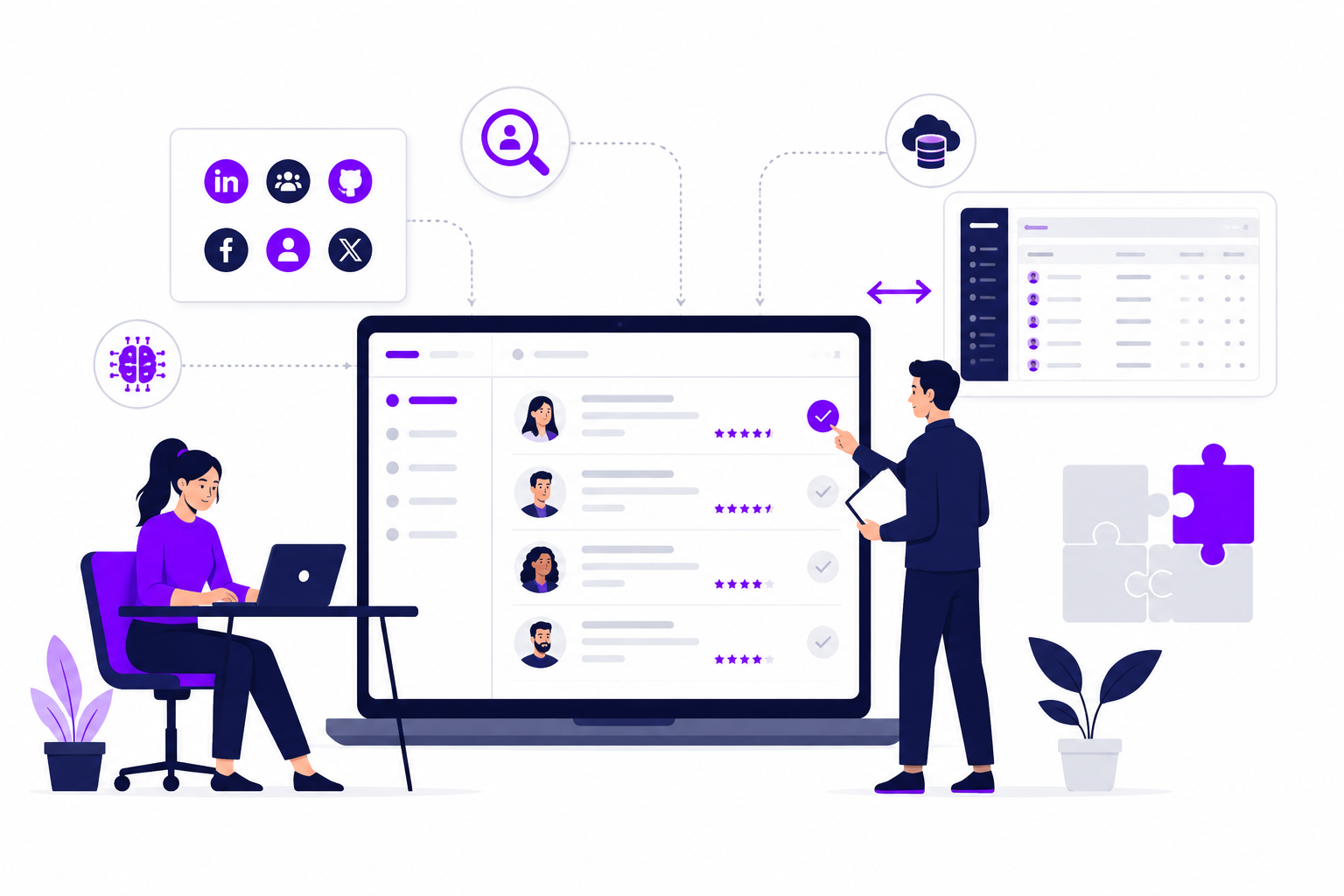
Most people picture sourcing as searching the open web for candidates, and that is part of it. But one of the most overlooked moves is looking inward first. Most companies already have a stack of qualified, previously screened candidates sitting untouched in old applications inside their own applicant tracking system. A good agent goes back through that history and resurfaces the people who match your current opening, instead of starting from zero every time a new role opens. Think of your ATS less like a filing cabinet and more like a talent pool you have already paid to build. This is the core idea behind AI sourcing.
Screening
This is the stage where people get the most surprised, and it is worth slowing down on. Some candidates have learned to hide invisible text in their resumes (white text on a white background) that instructs an AI reader to rate them as a strong match regardless of what their actual experience shows. This is a documented trick, not a rumor, and it works on any screening tool that simply feeds a raw resume into an AI model with no other checks in place.
The fix is not complicated, but it does need to be built in. A resume should be parsed into structured pieces first, skills, dates, roles, before any analysis happens, and that raw text should never be the only signal a system relies on. Pairing a resume with a short screening chat, a quick video response, or a skills check gives you something much harder to fake than a document alone. For more on this stage, see our guide to AI resume screening.
Engagement
This is the back and forth that eats up more recruiter time than almost anything else: answering the same candidate questions repeatedly, chasing replies, and keeping momentum going after that first message. An agent that handles this well keeps every conversation tied to the same candidate record, so nothing gets lost between a text message, an email, and a phone call. The candidate never has to repeat themselves, and the recruiter never has to dig through three different tools to remember where things left off. That is exactly what candidate conversations are built for.
Scheduling
Anyone who has tried to line up five calendars for one interview already knows why this stage matters so much. Good scheduling automation syncs calendars across the candidate, the recruiter, and the hiring manager, catches conflicts before they become a problem, and rebooks automatically if something falls through. The real win is not just saving time. It is removing the exact moment, the endless "does Tuesday at 2pm work" email chain, where good candidates quietly lose interest and stop responding.
Conversion
This is the handoff back to a person, and it is worth being specific about what actually gets handed over, because "then a human reviews it" is a meaningless sentence on its own. A good system gives a recruiter a ranked shortlist with a plain-language reason attached to each name, a clean summary of the screening conversation, and a flag on anything that looked off, like a possible fraud signal. That is the difference between a recruiter reviewing real information and a recruiter staring at a score with no idea how it was calculated.
What Makes Agentic AI Recruiting Tools So Helpful?
If you have used more than one recruiting tool at the same time, you already know the real problem agentic AI is solving. It is rarely about finding candidates. Most teams are decent at that part. The real breakdown happens in the follow-through, in the gap between the sourcing tool, the messaging tool, and the scheduling tool, where candidate context gets lost and recruiters end up doing the glue work by hand.
It remembers what happened three steps ago. A generative tool drafts something and stops there. Someone still has to pick that draft up and carry it into the next step by hand. An agentic tool carries its own context forward. It remembers that a candidate already answered a screening question, so it does not ask again, and it remembers what a recruiter noted about a candidate last week, so a follow-up message actually makes sense instead of restarting the conversation from scratch.
It shows up fast, and fast has a real payoff. Candidates who wait a day or two for a first response are far more likely to lose interest or take another offer. A system that reaches out within minutes of an application coming in closes that gap directly. This is often the single biggest lever for keeping good candidates from disappearing before a recruiter even sees their name.
It earns more responsibility gradually, instead of all at once. The best tools do not ask a team to hand over everything on day one. They let a team turn on the low-risk work first, like scheduling and reminders, prove that it works, and only then move into higher-stakes work like ranking and screening. That is a real design choice, and it is one of the clearest signs a tool was built by people who understand how trust gets built inside a talent team.
It explains itself. A ranking with no reasoning attached is not actually useful. It just creates more work, because now a recruiter has to double-check it before trusting it. A tool that shows why a candidate ranked where they did, in plain language, lets a recruiter act on the result quickly instead of redoing the analysis themselves.
Best Agentic AI Recruiting Tool in 2026: Curately.ai
By this point, you have a real framework for evaluating any tool in this space, so let's use it. Before naming names, here is what actually matters when comparing agentic AI recruiting platforms:
- Does it connect more than one stage of hiring, or does it just automate a single task and leave you to stitch the rest together yourself?
- Does it keep one shared candidate record across every stage, or does context get lost every time a candidate moves from one tool to the next?
- Does it verify the data it hands you, or are you finding out a phone number is dead after you have already spent time on it?
- Can your team set its own qualification and escalation rules, or are you stuck with someone else's defaults?
- Does it sit on top of the ATS you already have, or does adopting it mean a rebuild you did not sign up for?
Most teams end up running separate tools for sourcing, messaging, and scheduling, and losing a little candidate context every time someone moves between them. We call this the Frankenstack problem: a pile of point solutions that were never designed to talk to each other. Recruiters end up doing that stitching work by hand, checking one tool to see if someone replied, another to confirm they are qualified, a third to actually book the interview. It is a real drain, and it is the exact problem we built Curately to solve.
Curately keeps one candidate record connected across sourcing, engagement, and scheduling, so a recruiter is not rebuilding context every time a candidate moves forward. That connected structure is also why the contact data behind it matters so much. Curately checks a candidate's phone number and email against multiple data providers in real time before you ever see them, and if a contact cannot be verified, you are not charged for it. That is a specific, checkable claim, not a vague promise about "quality data," and it solves the most common complaint recruiters have about sourcing tools: reaching out only to find the number is wrong or the email bounces. It also connects to the ATS you already run, so adopting it does not mean a migration.
The results show up in the words of the people actually using it. Evan Zmarthie, an operations manager at a staffing firm called The Nurse Connection Staffing, described candidates who used to sit for 15 to 72 hours before anyone reached out. With Curately, they get a call back within about a minute, which helped the team reach roughly 10 percent more applicants. At AgileOne, senior manager of direct sourcing operations Lourdes Perez-Castillo pointed out that the bigger win was not just speed. It was keeping candidates engaged between openings, instead of starting from zero every time a new role came up. (Results like these vary by workflow and volume, worth keeping in mind as a real example rather than a guarantee.)
To be direct about who this fits best: Curately is built for teams running high-volume or repeated sourcing-to-schedule work, staffing firms, enterprise talent acquisition teams, and any high-volume hiring operation where the same steps repeat across dozens or hundreds of roles. If that sounds like your team, it is worth a look.
Agentic AI Recruiting Trends for 2026
A few shifts are becoming clear enough that it is worth planning around them, even if some of this is still taking shape.
Specialized agents working together, instead of one tool trying to do everything. Rather than a single AI trying to handle sourcing, screening, and scheduling all at once, expect more platforms built around a set of specialized agents that hand work off to each other, similar to how a hiring team already splits work between a sourcer, a coordinator, and a screener. Each agent gets narrower and better at its specific job, instead of one general tool doing everything at a mediocre level.
Hiring pipelines that never fully close. The old rhythm was open a role, fill it, close it, repeat. That is shifting toward pipelines that stay warm even when nothing is actively open, so a team is not starting from zero every time a new opening lands. This shows up most clearly in industries with constant, high-volume hiring needs, where the cost of restarting a search from scratch every time adds up fast.
A new kind of job inside talent teams: someone deciding what the AI handles and what a person handles. This gets talked about less than it should. As more of the hiring process gets automated, someone on the team needs to actively decide where the agent's job ends and a person's job begins, and that is not a decision made once and forgotten. It needs revisiting as tools improve and as trust builds. Expect this to become an ongoing responsibility inside talent teams, not a one-time setup task during onboarding.
More pressure to show your work, not just your results. Regulators are already treating AI used in hiring decisions as a serious matter. The EU's AI Act, for example, classifies AI systems used in employment decisions as high risk, with real requirements around explainability and human oversight. Expect vendors to increasingly compete on being able to show, clearly and on request, how a decision was reached, rather than simply claiming their system is fair.
Companies starting to hire for AI skills the same way they hire for any other skill. Zapier has built a formal scoring system for how comfortable and skilled every candidate is with AI tools, from casual use all the way up to fully rebuilding a workflow around AI, and it applies this to every role, not just technical ones. Expect more companies to formalize something similar in 2026. This is a quieter shift than the automation story, but arguably a bigger one. Agentic AI is starting to change what companies hire for, not just how they hire.
Risks and Limitations of Agentic AI in Recruiting
Every tool in this space will tell you about the upside. Fewer will tell you where it actually breaks, so let's go through that honestly. Knowing the failure points in advance is what protects you from them.
Fraud is a bigger problem than most teams realize until they start actively looking for it. When Zapier's team began actively screening for it, they found that as many as 20 percent of applicants for some high-volume technical roles showed signs of fraud: deepfakes, someone else sitting in on the interview, or answers that were clearly coached in real time. Their fix was not a single tool. It was a layered approach: automated checks that flag mismatches in IP address, location, and phone number, combined with bringing back live reference checks for finalists, something a lot of companies had quietly stopped doing in recent years.
Some candidates have learned to game AI screening directly, and it is worth knowing how. We touched on this earlier, but it deserves its own mention as a risk, not just a technical detail. Hidden white-on-white text inside a resume can instruct an AI reader to rate a candidate highly, regardless of their real experience. This is a demonstrated weakness, not a hypothetical one. If a screening process feeds a raw resume straight into an AI model with nothing else checking it, that gap is real and exploitable.
Bias does not disappear just because a human is no longer making the call. The best known cautionary tale here is worth remembering in detail. Reuters reported in 2018 that an internal recruiting tool Amazon had built years earlier taught itself to penalize resumes containing the word "women's," things like "women's chess club captain," because it had trained on a history of resumes mostly submitted by men. Amazon scrapped the tool once this came to light. The lesson is not that AI screening is inherently unfair. It is that the data a system learns from has to be actively checked, and that check needs to happen on a recurring basis, not just once when a tool first gets set up.
Automating a task does not automatically make it better, and teams should measure that instead of assuming it. There has been real, recently reported research on experienced software engineers using AI coding tools, and the finding was counterintuitive: many of them enjoyed the work more, but their actual output measured slower, not faster. A similar gap can show up in recruiting. A tool that feels faster to use is not the same as a tool that is actually producing better hires or shorter time to fill. Track your own before-and-after numbers, and do not assume speed just because a step got automated.
Rolling out too much, too fast, is what actually kills most of these projects. Handing a team high-stakes automation, like candidate ranking, before it has had a chance to build trust through lower-stakes wins, like scheduling, is one of the most common reasons rollouts fail. It is rarely the technology's fault when this happens. It is almost always a sequencing problem, and it is completely avoidable.
How to Implement Agentic AI in Your Recruiting Process
If everything above feels like a lot, here is the good news: you do not need an enterprise transformation program to get this right. A small, deliberate rollout works better anyway.
Start with one workflow, not your whole hiring process. Pick the single role or workflow causing you the most pain right now, usually your highest-volume one, and pilot there first. Set two or three numbers you will actually track before you start, like time to first contact, drop-off rate, or hours saved per recruiter. Run the tool in "recommend, don't decide" mode at first, meaning a person reviews every output before anything moves forward. Only expand once you have hit a bar you agreed on ahead of time. This whole plan should fit on one page. If it does not, it has gotten too complicated.
Hand over tasks in order of risk, not all at once. Start with the lowest-stakes work: scheduling, reminders, status updates. Move into medium-stakes work, like resume screening and candidate ranking, once the low-stakes work has earned some trust. Keep the highest-stakes work, interview evaluation and final hiring decisions, with people, indefinitely. This is simply the order that actually works, based on what teams who have done this successfully have found.
Do not treat this as a reason to rip out your ATS. A lot of hesitation around adopting agentic AI comes from an assumption that it means a massive system migration. It usually does not. The practical approach is treating your existing applicant tracking system as your system of record and letting the agentic layer sit on top of it, pulling from and feeding back into the data you already have. That removes most of the fear before it even becomes a real conversation.
Tell candidates plainly when they are talking to AI, and what is and is not okay for them to use. This is good practice, not just good ethics. Add a short, plain statement at the start of your application process that tells candidates what kind of AI use is fine on their end and what crosses a line, and be clear about the moment a candidate is about to interact with an AI system instead of a person. Zapier does exactly this, and it has held up well with candidates because nobody feels tricked.
Bring your own team along, not just your candidates. The rollouts that stick are the ones where a team builds AI into things they are already doing, a regular team meeting, an internal chat channel for questions, someone demoing one small AI-assisted workflow to the group, rather than a one-time training session everyone forgets about within a month. Be direct with your team that the goal is changing what they spend time on, not replacing them. Said out loud, that distinction removes most of the resistance before it starts.
FAQs on Agentic AI in Recruiting
How is agentic AI actually used in recruitment?
Mostly for the repetitive, multi-step parts of the process: searching for candidates, reaching out, following up, screening at the top of the funnel, and scheduling interviews. It hands a recruiter a shortlist or a scheduled interview instead of a to-do list of steps to work through by hand.
Which AI is best for recruiting?
It depends entirely on what you are trying to fix. A tool that is excellent at sourcing is not automatically good at screening or scheduling. Use the criteria covered earlier in this guide, whether it connects multiple stages, keeps one shared candidate record, and verifies the data it gives you, to judge any specific option, including the one we build.
How is agentic AI different from basic automation?
Basic automation follows a fixed rule: if this happens, do that. It cannot handle anything outside the rule it was given. Agentic AI can look at a situation, decide what the best next step is, and adjust if something changes, without someone rewriting the rule every time a new scenario comes up.
Will agentic AI replace recruiters?
No, and it is worth being direct about why. It changes what tasks a recruiter spends time on, not whether the job exists. Final hiring decisions, relationship building with candidates and hiring managers, and judgment calls about fit are not things these systems are built to do, and they should stay with people.
Is it legal to use AI to screen candidates?
Generally yes, but it comes with real requirements depending on where you operate. In the US, the EEOC has issued guidance on how existing anti-discrimination law applies to AI-based hiring tools, and some states, like Illinois, have their own specific rules around AI analysis of video interviews. The EU AI Act treats AI used in employment decisions as high risk, with added requirements around transparency and oversight. This is general information, not legal advice. Talk to your own legal counsel about what applies to your specific situation.
Conclusion
If you remember nothing else from this guide, remember three things. Start with one low-risk task, not your whole process. Keep final hiring decisions with people, always. And when choosing a tool, pick one that keeps candidate context connected from the first message to the scheduled interview, rather than one more tool you have to stitch together with the others.
None of this requires betting your entire hiring process on new technology overnight. The teams getting real value out of agentic AI right now are the ones who picked one painful, high-volume workflow, tested a tool against it with clear numbers in hand, and expanded only once it earned that next step. That is a smaller ask than it sounds, and it is the approach we would recommend even if we did not build tools in this space ourselves.
Go back to where this guide started: a recruiter staring at 500 applications, knowing 499 of them look good on paper, with no real way to tell which ones are actually right for the role. That is the problem agentic AI is meant to solve. Not by taking the decision away from you, but by clearing enough of the noise that you can see the signal underneath it, and make that decision yourself, with the time and the information to do it well.