Recruiting has always involved a strange combination of pattern recognition, persistence, and luck.
You search for candidates, review profiles, send outreach, wait for responses, adjust the search, repeat the process, and eventually discover that the ideal candidate changed jobs three weeks ago and now lives somewhere else entirely.
For a long time, this workflow depended almost entirely on manual effort. Recruiters built Boolean searches, scanned resumes individually, and managed outreach one conversation at a time.
Now we have AI candidate sourcing tools doing a large portion of that work automatically. In fact, according to McKinsey, 92 percent of companies plan to increase their AI investments over the next 3 years, which naturally leads to a bigger question:
Can AI tools replace manual sourcing?
The answer is complicated enough to deserve more than a dramatic headline, and less complicated than some vendors would prefer.
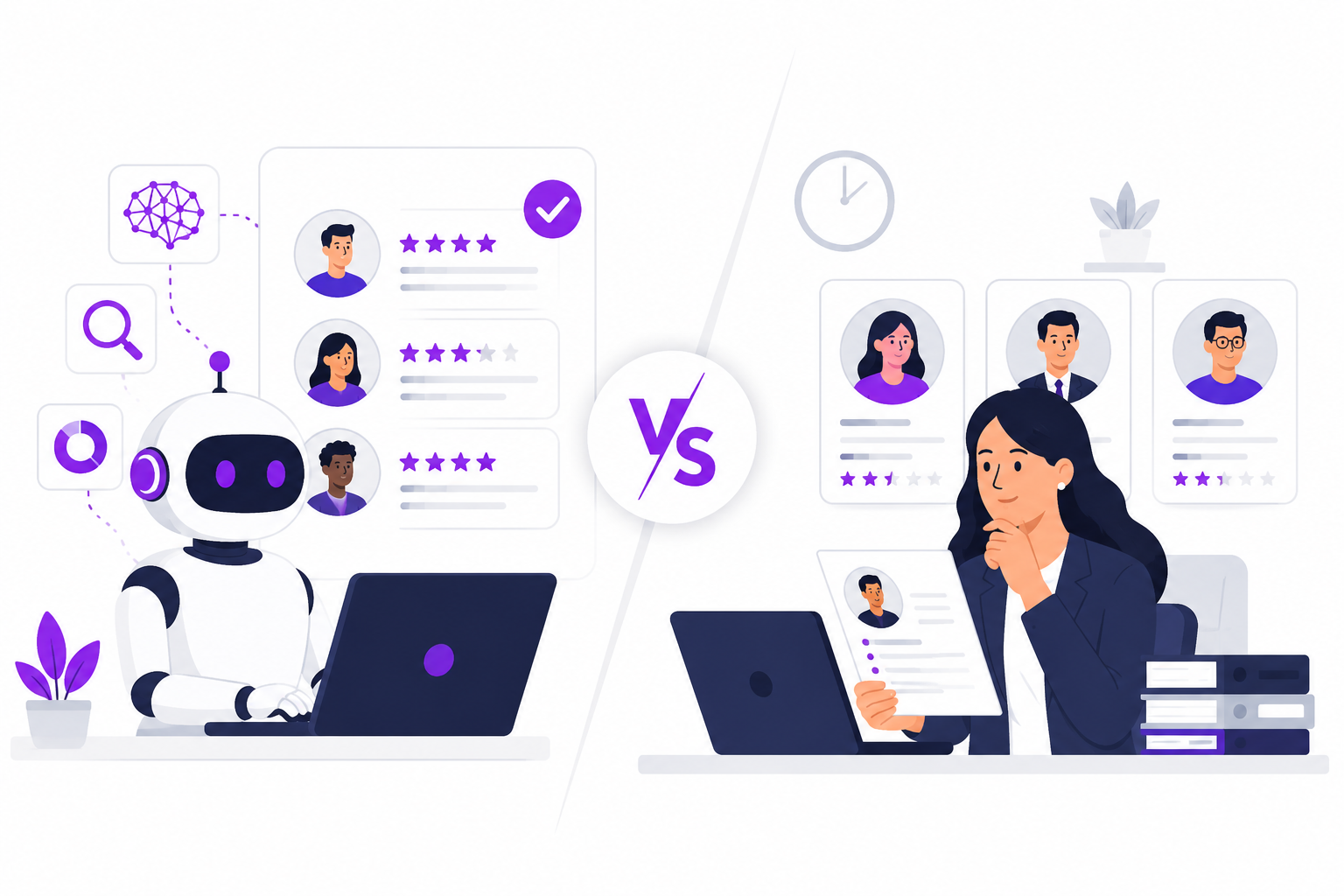
AI Sourcing vs. Manual Sourcing
The easiest way to understand the difference is to look at how each approach handles information.
Manual sourcing relies on recruiters building searches directly. They decide which keywords matter, which job titles are relevant, and where to search. Results depend heavily on the recruiter's familiarity with the role and the quality of the search logic.
This works reasonably well until the search becomes complex.
A recruiter looking for software engineers, for example, may need to account for:
- equivalent titles
- adjacent technologies
- inconsistent resume wording
- transferable experience
At that point, the process starts resembling a small logic puzzle with unpredictable inputs.
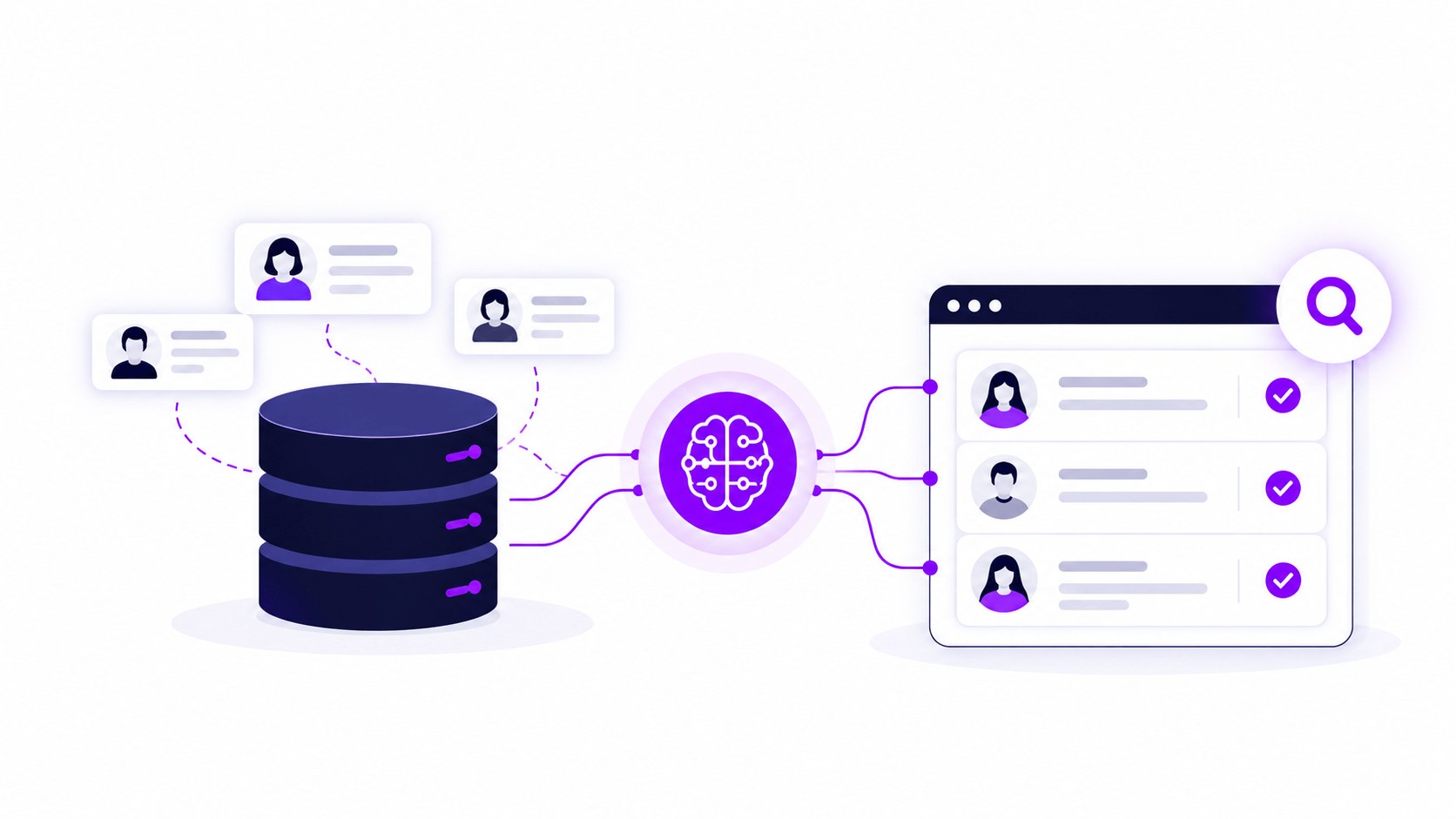
AI sourcing approaches the same problem differently. Instead of depending entirely on exact matches, it evaluates relationships between skills, experience, titles, and behavioral patterns across large datasets.
That changes the search process from: "Find candidates who exactly match these terms" to something closer to: "Find candidates who are likely relevant, even if the wording differs."
The distinction matters because real candidates rarely organize their experience in consistent ways.
How AI Tools Help in Candidate Sourcing
Most modern AI recruiting tools focus on three major sourcing problems:
- finding candidates faster
- improving relevance
- reducing repetitive manual work
Each of these sounds fairly straightforward until you look at how much recruiter time disappears into them.
AI Expands Candidate Discovery
Traditional sourcing depends heavily on keyword matching.
If a recruiter searches for "backend engineer," candidates using titles like "platform developer" or "systems engineer" may never appear, even if their experience overlaps significantly.
AI sourcing tools evaluate broader relationships between skills and experience. They can recognize that candidates with adjacent backgrounds may still fit the role.
This becomes especially useful in technical recruiting, where titles vary wildly between organizations.
AI Handles Large Volumes More Efficiently
Manual sourcing slows down as datasets grow.
Reviewing thousands of profiles individually is not difficult in theory. It is simply time-consuming in a way that becomes impractical very quickly.
AI-powered recruitment tools process large datasets continuously and prioritize candidates based on relevance scores, engagement likelihood, or hiring criteria.
Recruiters still review the results. The difference is that now they begin with a narrower, more useful set of profiles.
AI Automates Repetitive Workflows
Candidate sourcing involves more than searching. There is outreach, follow-up communication, scheduling, tagging, status tracking, and database management.
Many of these tasks follow predictable rules, which makes them suitable for automation.
This is where recruitment workflow automation becomes valuable. AI systems can maintain engagement and administrative consistency without requiring recruiters to manually handle every interaction.
How Recruiters Use AI in Candidate Sourcing
There is a tendency in recruiting discussions to describe AI as either revolutionary or dangerously overhyped.
The reality is much more operational.
Most recruiters use AI as an acceleration layer on top of existing workflows.
Natural Language Sourcing
One of the more useful developments in candidate sourcing software is natural language search.
Instead of building complicated Boolean strings, recruiters can describe candidates conversationally.
Something like:
"Senior Java engineer with fintech experience in Chicago who has worked on distributed systems."
The AI system interprets the request and expands the search automatically.
This reduces the amount of technical search expertise required to source effectively. For a deeper comparison, see our guide on Boolean search vs AI sourcing.
Candidate Ranking and Prioritization
AI systems also help recruiters prioritize attention.
Not every candidate will be a fit for every role. Some are highly aligned, while others are technically relevant but less likely to engage.
AI sourcing tools evaluate these patterns continuously, which helps recruiters focus their time more efficiently.
Automated Candidate Outreach
Many sourcing platforms now include outreach automation.
Messages can be personalized using candidate background data, while follow-ups happen automatically based on engagement behavior.
This improves consistency, particularly in high-volume recruiting environments where manual follow-up becomes difficult to maintain.
Can AI Tools Replace Manual Sourcing?
The answer you've been waiting for: No.
That answer disappoints people who wish that everything could just be done automatically, though recruiting has never been especially cooperative in that regard.
AI performs extremely well in areas involving:
- large-scale data processing
- repetitive workflows
- pattern recognition
- candidate discovery
- initial candidate screening
Recruiters remain essential for decision-making and evaluating context that does not fit neatly into structured systems. As elegantly put in a 1979 IBM training manual: "A computer can never be held accountable, therefore a computer must never make a management decision."
For example:
- assessing motivation
- understanding interpersonal dynamics
- identifying nuanced culture alignment
- building trust with candidates
These are not small details. They influence hiring outcomes directly.
AI sourcing also depends heavily on the quality of underlying data and workflow design. Poorly structured hiring processes remain inefficient even when AI is layered on top.
This is why most effective recruiting organizations use a hybrid approach.
AI handles the operational load associated with sourcing and workflow management. Recruiters focus on decision-making, relationship-building, and evaluation.
That division of labor tends to produce better results than either approach independently.
How Platforms Like Curately Fit Into This
Curately approaches sourcing as part of a connected workflow rather than an isolated activity.
Recruiters can source candidates using natural language instead of Boolean logic, refine searches interactively, and apply hiring criteria dynamically as the system learns from recruiter feedback.
The platform also integrates sourcing with engagement and screening workflows. Candidates can be contacted automatically, screened through AI-assisted interactions, and moved through hiring stages without rebuilding context between systems.
This reduces friction that typically appears when sourcing, outreach, and screening operate in separate platforms.
The practical effect is not that recruiters disappear, but instead that recruiters spend less time fighting software and more time making hiring decisions.
Conclusion
AI sourcing changes how recruiters interact with candidate data.
Manual sourcing depends heavily on search construction and repetitive review processes. AI sourcing systems process larger datasets more efficiently and surface candidates based on broader patterns of relevance.
That produces measurable gains in speed and workflow efficiency.
Recruiting still depends on judgment, communication, and relationship-building. Those elements remain difficult to automate in a meaningful way because people rarely behave in perfectly structured, predictable patterns.
Which, admittedly, is inconvenient for software systems but fairly standard for human beings.
Frequently Asked Questions
What is AI sourcing in recruiting?
AI sourcing uses machine learning and automation to identify, rank, and engage candidates based on skills, experience, and behavioral patterns.
Can AI tools replace recruiters?
AI tools automate sourcing and repetitive workflows, though recruiters still handle evaluation, communication, and hiring decisions that require human judgment.
What are the benefits of AI candidate sourcing tools?
AI candidate sourcing tools improve search speed, expand candidate discovery, automate outreach, and reduce manual administrative work.
How does AI sourcing compare to Boolean search?
Boolean search relies on exact keyword logic. AI sourcing evaluates broader relationships between skills, titles, and experience, which helps surface candidates who may not appear in traditional searches.
What is the best AI sourcing platform for recruiters?
Platforms like Curately combine AI sourcing, engagement, and workflow automation into a single recruiting system, which helps reduce manual effort and improve sourcing efficiency.