

Here's a number worth sitting with: only about 28% of the US workforce is actively looking for a new job at any given moment. The other 72% already has one, and most of them aren't scrolling job boards on their lunch break.
Yet a lot of hiring budgets are still built as if everyone is out there searching.
That gap, between where the money goes and where the candidates actually are, is exactly the problem recruitment advertising exists to solve.
If you've ever posted a role on three job boards, waited a week, and pulled in twelve applications with maybe two worth a phone screen, you already know this feeling. The job board did its job. It just didn't do yours. Recruitment advertising is what happens when a team stops posting and starts reaching, putting budget and messaging in front of the right person whether they're actively searching or not.
This guide covers what recruitment advertising actually means, what it costs, which channels earn their spend, how the process works when it's done well, and ten campaigns that produced real results instead of just applause.
What Is Recruitment Advertising?
Recruitment advertising is the paid, deliberate work of getting a job in front of the right person, on the channels where that person actually spends time, with a message strong enough to make them click and apply. It's not the same as simply posting a job. It's the decision about where a role appears, how much you're willing to spend to get someone to see it, and how you make the opportunity compelling enough that a qualified person takes the next step.
One way to picture it: if job boards are the shelves, recruitment advertising is the merchandising, the choice of where each job appears, how much to spend, and how to make the offer stand out enough that someone actually applies.
Recruitment Advertising vs. Job Advertising vs. Recruitment Marketing
These three terms get used interchangeably, and they shouldn't be, because mixing them up is a common way budgets get wasted.
Job posting is the simple act of publishing a role somewhere, your careers page or a single job board. It's one action, and it's usually free or close to it.
Recruitment advertising is the paid, ongoing effort to promote that posting across multiple channels, optimize what you're spending on each one, and drive completed applications, not just clicks. Posting is one piece of it.
Recruitment marketing is the broader, longer-term work of building your employer brand and nurturing a pipeline of interested people before a role even opens, so that by the time you do advertise something, people already know and trust the company. If that's the side you're weakest on, start with these steps to optimize your recruitment marketing strategy.
The distinction isn't just semantic. It changes what you should be measuring and what you should be budgeting for. Recruitment marketing gets judged over months, on brand awareness, follower growth, and pipeline size. Recruitment advertising gets judged this week, on cost per applicant and time to fill for one specific role. Mix the two up and you'll either judge a long-term brand campaign by short-term hiring numbers, or judge a job ad by how many people liked the post. Neither tells you what you actually need to know.
Benefits of Recruitment Advertising
Most articles on this topic will tell you recruitment advertising gives you wider reach and stronger employer branding. That's true, and also vague enough to be close to meaningless. The actual data says something more specific.
It builds brand recall, even among people who aren't job hunting. Comcast Advertising ran a study comparing a branding ad for a home improvement company against a recruitment ad from the same business, same logo, same treatment. Viewers of the recruitment ad were 1.7x more likely to recall the brand name than viewers of the standard product ad. Recall was actually highest among people who weren't looking for a job in that field at all. They were still paying attention.
It moves people from curious to interested, especially with real employee voices. In the same research, 63% of viewers who were job hunting in the advertised field said they were interested in the company after seeing the ad. When the ad included emotional elements, like an employee talking about their own experience, interest jumped another 39%. A generic "we're hiring" post and a short clip of a real employee are not the same tool, and the numbers back that up.
It does double duty as a consumer ad, whether you plan for that or not. Nearly half the people in that same survey said the main point of a recruitment ad wasn't recruiting at all. They read it as brand promotion. If you're already paying for the media, that's a benefit landing in your lap for free, as long as the ad is actually good.
Programmatic buying can produce results that flat-rate posting never will. One staffing company, I.K. Hofmann USA, connected its applicant tracking system directly to its job board spend and let an automated setup reallocate budget based on what was actually converting. Applicant rate rose 966%. Return on investment landed at 102%. That's not a small optimization. That's the difference between a role sitting open for months and getting filled.
The thread running through all of this: recruitment advertising works when it's treated like advertising, with real creative, real targeting, and real measurement, not like a formality completed by clicking "post" on a job board.
Best Recruitment Advertising Channels
There's no single best channel. There's a best channel for this role, at this moment, for this kind of candidate. Matching the two comes down to a few patterns.
Job boards, for high-volume and actively searching candidates. Filling call center seats, warehouse positions, or seasonal retail roles, job boards still earn their keep because the people browsing them are actually looking, right now, with intent to apply. This is also where large administrative or entry-level IT talent pools tend to live, and it pairs well with a proper high-volume hiring approach.
LinkedIn, for hard-to-fill and specialized roles. When the qualified pool is small and mostly already employed, LinkedIn's professional targeting, by job title, seniority, skills, and years of experience, is worth the higher cost per click. This isn't fishing in a big pond. It's finding a specific fish. It's also the channel where attracting passive candidates is most realistic.
Instagram, for creative and culture-forward roles. Design, marketing, and creative positions tend to get more engagement here because the format rewards visual storytelling over a bulleted job description.
TikTok, for trades and younger candidates. Short, vertical, unpolished clips of real crews or real employees outperform anything that looks like a produced ad here. This is also where short video resumes have picked up genuine traction for hourly and entry-level roles, and it's part of solving the wider set of Gen Z hiring difficulties.
Search ads, for candidates actively researching a role or company. These catch people typing a company name plus "salary" or a job title plus "requirements" into a search engine, which means they're further along than someone scrolling social media.
Display and career site retargeting, for employer brand and niche roles. These work best as reinforcement, keeping a name in front of someone who already saw a job ad somewhere else, rather than as the first touch.
If paid social is part of the plan, a few mechanics matter more than people expect:
- Choose a traffic-focused campaign objective, not engagement or awareness. That setup sends people to an application landing page and charges per click instead of per impression, which is what actually matters for a job ad.
- Build a custom audience from people who've already visited the careers page, then let the platform find lookalikes, people who share traits with that group. This usually outperforms a broad audience built purely on demographics.
- Cap how often the same person sees an ad at around three views. Past that point, showing it a fourth or fifth time doesn't convert anyone. It just gets the ad flagged as repetitive, which hurts reach.
None of this replaces testing. It just means testing doesn't have to start from a blank slate.
Programmatic Recruitment Advertising
Programmatic recruitment advertising gets described as "automated job ads," which makes it sound like something set up once and left alone. That's not quite it, and the difference matters.
What's actually happening is a five-step loop that runs continuously.
- Sourcing. Open roles feed in from the applicant tracking system, either automatically or entered manually.
- Distribution. Each job gets pushed to a mix of channels, job aggregators, search engines, social platforms, and niche boards, based on what fits that role.
- Budget allocation. Spend gets assigned per job, not spread evenly across the whole account. A hard-to-fill engineering role and an easy-to-fill retail role shouldn't draw from the same pot just because they're both open.
- Optimization. As applications come in, spend shifts toward whatever's actually converting and pulls back from what isn't. This happens continuously, not once a month when someone remembers to check.
- Measurement. Everything gets tracked back to its source, so the real cost per applicant, and where tracking allows it, the real cost per hire, is actually known.
The step that creates most of the value is number four, the constant reallocation. Done manually, most recruiters check performance once a week if they're diligent, then adjust. A programmatic setup adjusts in something closer to real time, so budget stops flowing to a channel that stopped working three days ago instead of three weeks ago.
The I.K. Hofmann USA example from the last section is worth revisiting here. Their jump to a 966% higher applicant rate and 102% ROI didn't come from a bigger budget. It came from connecting their applicant tracking system to their job board spend and letting reallocation happen automatically, instead of someone doing that math by hand every few weeks.
For teams managing more than a handful of open roles at once, this is usually the point where the math starts favoring a programmatic approach over manual, channel-by-channel management. No single person can rebalance budget across a dozen roles every day and still have time to actually recruit.
How Much Does Recruitment Advertising Cost?
There's no flat answer here, and anyone offering one number is oversimplifying. What matters more is understanding the pricing models and which one fits the situation.
Flat-rate or duration pricing charges a fixed fee to keep a job posted for a set period, say 30 days, regardless of outcome. The cost is known upfront, which is nice for budgeting. The risk is paying the same whether the role gets one applicant or a hundred. For an easy-to-fill role with no time pressure, that's usually fine. For anything urgent or hard to fill, it's a gamble.
Cost per click (CPC) charges only when someone clicks the ad. This is paying for attention, not yet for a result.
Cost per applicant (CPA) charges only when someone finishes an application. This ties spend more directly to outcomes, which is why most programmatic buying is built around it.
This is the part that actually changes how to think about cost: cost per applicant is not the finish line. It's the middle of a longer chain, and stopping there is exactly how teams end up overspending on channels that bring in a lot of people who were never going to get hired anyway.
The full chain looks like this:
- Cost per click, what it costs to get someone to the apply page.
- Apply rate, the percentage of those clicks that turn into a completed application. A slow or clunky application form quietly kills this number.
- Cost per applicant, total spend divided by completed applications.
- Cost per quality applicant, the same number, filtered down to people who actually pass initial screening.
- Cost per hire, by source, which channel actually produced people who got hired, not just people who applied.
A channel can look cheap at step three and expensive at step five. If one job board delivers applicants for $8 each but almost none pass screening, and another delivers applicants for $15 each with a much higher pass rate, the $15 channel is the better deal. Most teams never run that comparison. They stop measuring at cost per applicant, see a low number, and assume the channel is working.
If there's one thing worth taking from this section, it's this: track metrics all the way through to hire, by source, even when it takes extra setup work. It's the only way to know whether a channel is producing good candidates or just producing clicks.
How to Create the Best Recruitment Advertising Strategy
Skip the strategy deck. The actual sequence, in order, that moves a team from "we need to hire someone" to "we have qualified applicants," looks like this.
1. Define the actual hiring need, not just the job title. Before writing a single word of ad copy, get clear on what the role needs to do, which skills are genuinely required versus nice-to-have, and how many people are actually needed. A vague hiring need produces a vague ad, and a vague ad produces the wrong applicants.
2. Build a real candidate persona, using data, not guesswork. This isn't the exercise where someone invents a fictional person named "Marketing Mary" in fifteen minutes. Talk to the hiring manager and current employees in similar roles. Look back at the last several successful hires for this type of position and find the patterns: background, experience level, where they came from, what actually made them a good fit. That's the persona. It should be specific enough to describe where this person spends time online.
3. Set a specific, measurable goal for this role, not one number for the whole hiring plan. "Hire more people this quarter" isn't something to act on. "Get 40 qualified applicants for this role within three weeks, at under $25 per quality applicant" is something a campaign can actually be built around and checked against.
4. Choose channels based on the persona, not habit. A passive, mid-career specialist won't be reached by a job board post alone. Someone actively hunting and price-sensitive about their next move might be reached by exactly that. Match the channel to the person, not to whatever was posted last time.
5. Set the budget per role, not one lump sum for the whole account. This is the step most teams skip, and it's probably the single biggest lever available. A hard-to-fill specialist role and a role filled every month from a large applicant pool are not the same problem, and they shouldn't draw from the same undifferentiated pot of money. Decide what's affordable to spend per quality applicant for this specific role, then budget to that number.
6. Make sure the career site and application form don't waste the traffic being paid for. A lot of recruitment advertising spend quietly disappears here. A great ad can get someone to click, then lose them because the application takes fifteen minutes to complete on a phone, or the careers page takes eight seconds to load. Keep the application short, make it work on mobile, and make sure the page is findable by search, not just reachable through the paid link.
7. Measure results back to the source, every time. Know which channel, which specific ad, and which job board actually produced the hires, not just the applicants. Without this, step five next quarter is just a guess again.
Do these seven things in order and most of what a typical "ultimate guide" spends three thousand words dancing around is already covered.
10 Best Examples of Recruitment Marketing
Reading about strategy only goes so far. Here are ten real campaigns, each using a genuinely different approach, with the actual reason each one worked.
1. McDonald's Snaplications
McDonald's let hourly candidates start an application inside Snapchat, taking about ten seconds to begin, instead of sending them somewhere else to fill out a form. It met candidates on a platform they were already using all day and removed the friction of leaving that app entirely.
Why it worked: if the ideal candidate for a role spends their day on a specific platform, the application needs to start there too, not three clicks away.
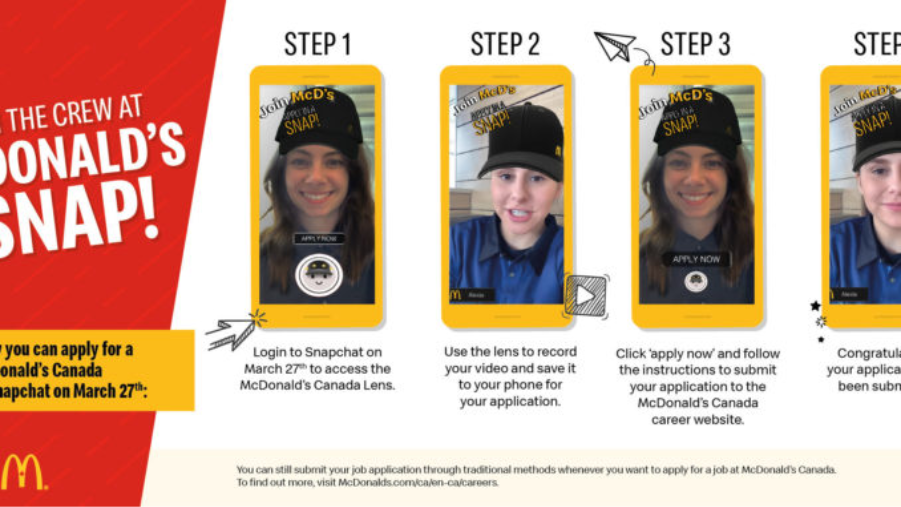
Image source: senecajournalism.ca
2. IKEA's "Co-worker" experience on Roblox
IKEA opened real, paid roles inside a branded interactive world built on Roblox, letting candidates experience the culture and the work before ever submitting an application. IKEA isn't a natural tech destination, so instead of trying to win over digital-native candidates with copy, they let the experience do the persuading.
Why it worked: for roles where the employer brand doesn't naturally attract the audience needed, an interactive preview of the actual work can do more than any amount of ad copy.
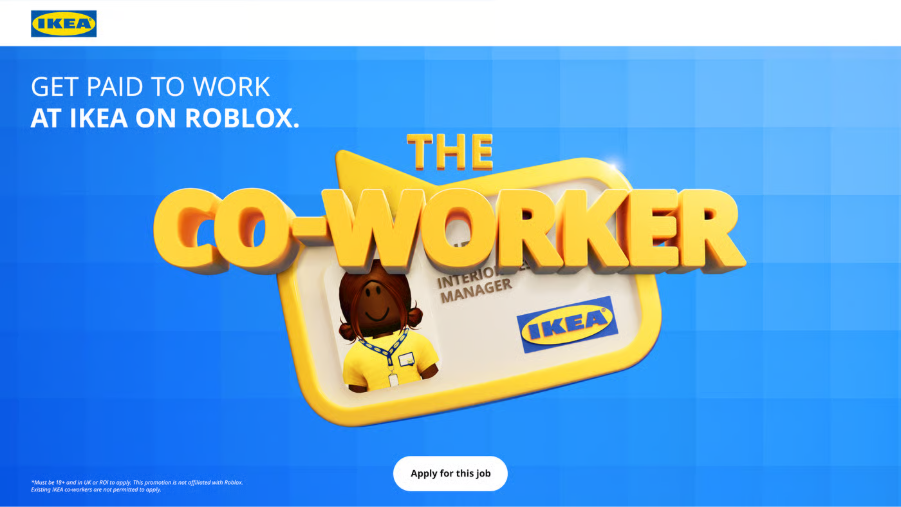
Image source: ikea.com
3. Land O'Lakes' "Feed the Nation" campaign
Land O'Lakes ran geo-targeted Facebook ads aimed at specific locations, reaching roughly 19,000 people and generating 162 leads, with 25 completed applications, in under two weeks.
Why it worked: a small, sharply targeted audience with a clear message usually out-converts a broad one, even on a modest budget.

Image source: phenom.com
4. IKEA's job-in-the-box campaign
IKEA printed job openings directly inside its product boxes shipped to customers, with essentially zero media spend, and generated 4,285 applications.
Why it worked: existing customers are often a completely untapped recruiting channel, and reaching them doesn't always require ad budget.
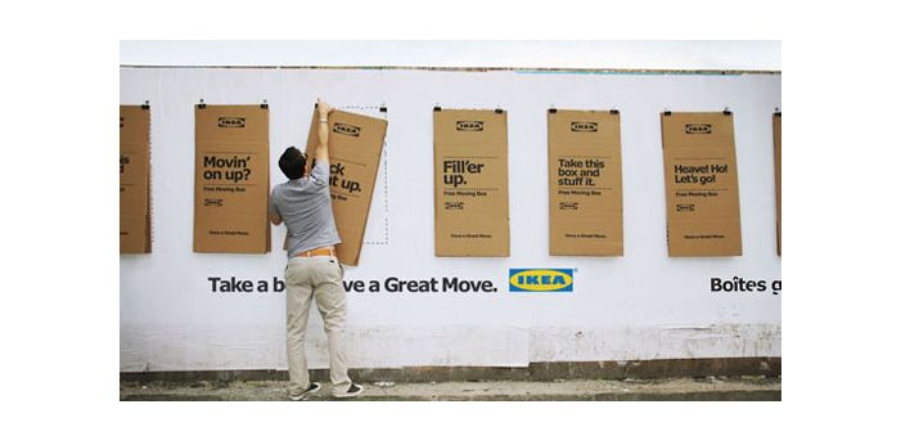
Image source: pinterest.com
5. Sprout Social's employee testimonial video
Instead of a polished, scripted recruiting video, Sprout Social built a campaign around real employees talking about flexibility and work-life balance in their own words.
Why it worked: candidates can tell the difference between a script and a real person. A slightly rough video of a genuine employee usually outperforms a highly produced one that feels rehearsed.
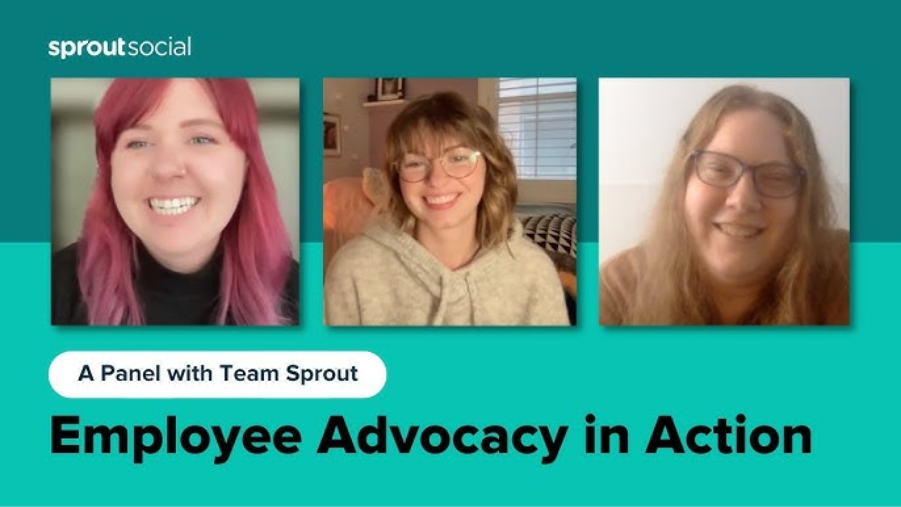
Image source: Sprout Social
6. Amazon's virtual Career Day
Amazon ran an all-digital hiring event that drew more than 300,000 attendees, combining coaching sessions, role-specific talks, and live Q&A into a single window.
Why it worked: a time-boxed event creates urgency an evergreen job posting never will, and it turns a dozen small, disconnected recruiting efforts into one coordinated push.
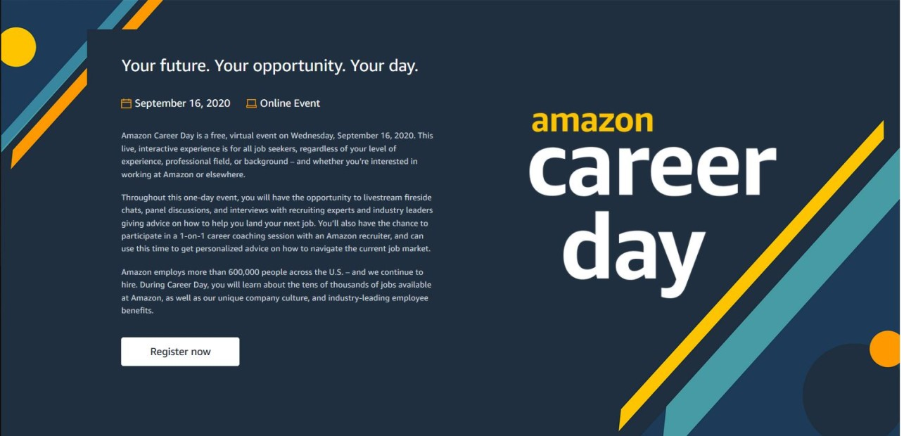
Image source: linkedin.com
7. Southwest Airlines' referral program overhaul
Southwest rebuilt its employee referral program with better incentives and simpler technology, and saw referrals increase by 700%.
Why it worked: existing employees already know what a job is really like and who would actually be a good fit. It's worth checking whether a referral program is easy to use before spending more on outside advertising.

Image source: nytimes.com
8. Buffer's salary-first careers content
Buffer publishes its actual salary formula and pay ranges publicly, then leads its recruiting content and ads with that information instead of burying it on page three of a listing.
Why it worked: research from SHRM found that listing salary ranges helped 70% of organizations attract more candidates. If transparency laws or candidate expectations are already pushing a company there, the number should be where people see it first.
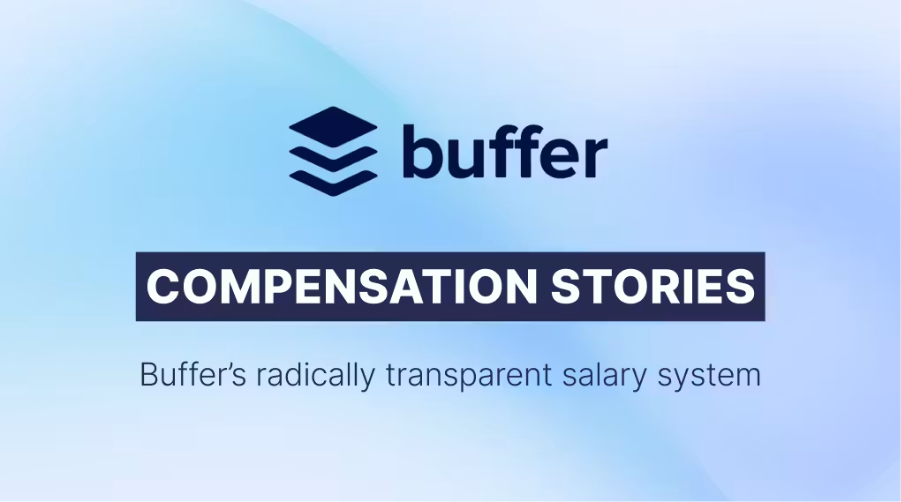
Image source: ravio.com
9. Toggl's skills test campaign
To hire an SEO manager, Toggl built a public skills challenge, promoted it on social media, and offered a free t-shirt to anyone who scored well.
Why it worked: reaching passive candidates doesn't require a large budget. It requires a reason for them to engage that has nothing to do with applying for a job, yet.
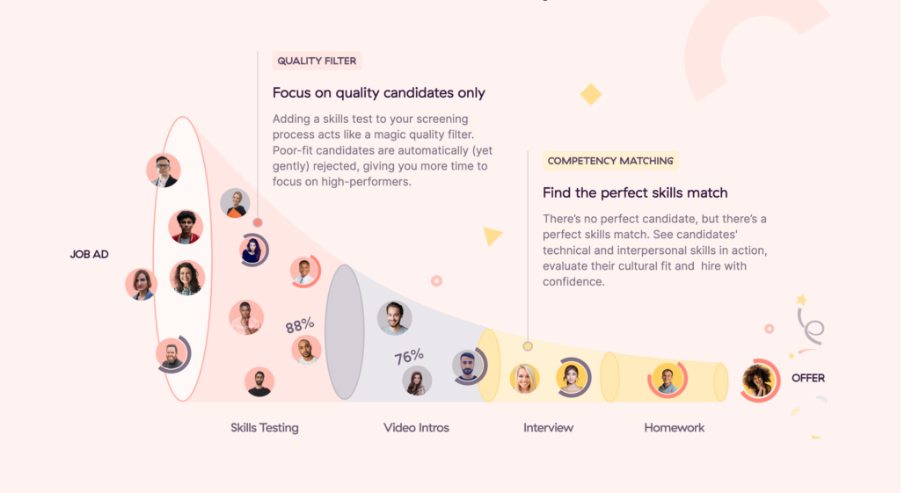
Image source: toggl.com
10. Volvo's "Recruiting Car"
At a major auto show, Volvo built AI conversation technology into one of its own cars, letting the vehicle itself interview candidates for open R&D engineering roles.
Why it worked: if a product already demonstrates technical capability, building the recruiting pitch around it is more convincing than any separate ad could be. It's an early, very physical version of what voice AI in enterprise talent acquisition now does at scale.
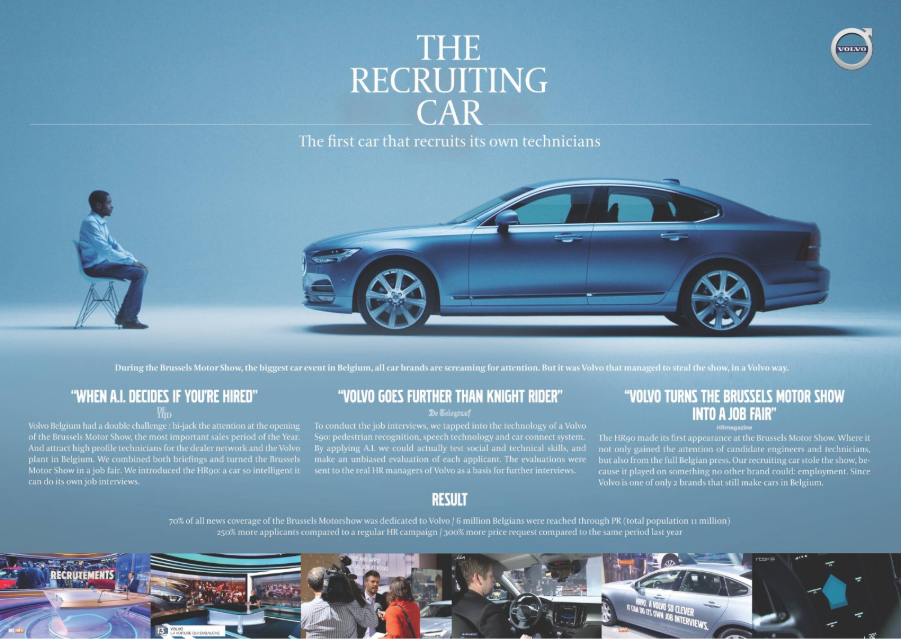
Image source: adsoftheworld.com
Don't Let Your Recruitment Advertising Spend Go to Waste
Everything covered so far gets a qualified person to click an ad and finish an application. That's real work, and it costs real money. But getting someone to apply and actually hiring them are two different problems, and a lot of teams only solve the first one.
Here's what that looks like in practice. A candidate applies on a Tuesday. Nobody reaches out until the following Monday because the recruiter was buried in other requisitions. By then, that candidate has already talked to two other companies, and one of them moved faster. The ad worked. The follow-up didn't. That's the gap a candidate engagement platform is built to close.
Industry data puts average application-to-hire conversion around 8 to 12%, which means most of what recruitment advertising spend produces is currently walking out the door somewhere between apply and offer, not because the candidates weren't good, but because the process behind the ad couldn't keep pace with it.
Getting the right person to a job ad and turning that person into a hire are genuinely different problems. Solving the first one well, then losing candidates to a slow or manual process on the back end, is one of the more common and least discussed ways recruitment advertising budgets go to waste. It's worth checking honestly which side of that gap a team is actually stuck on.